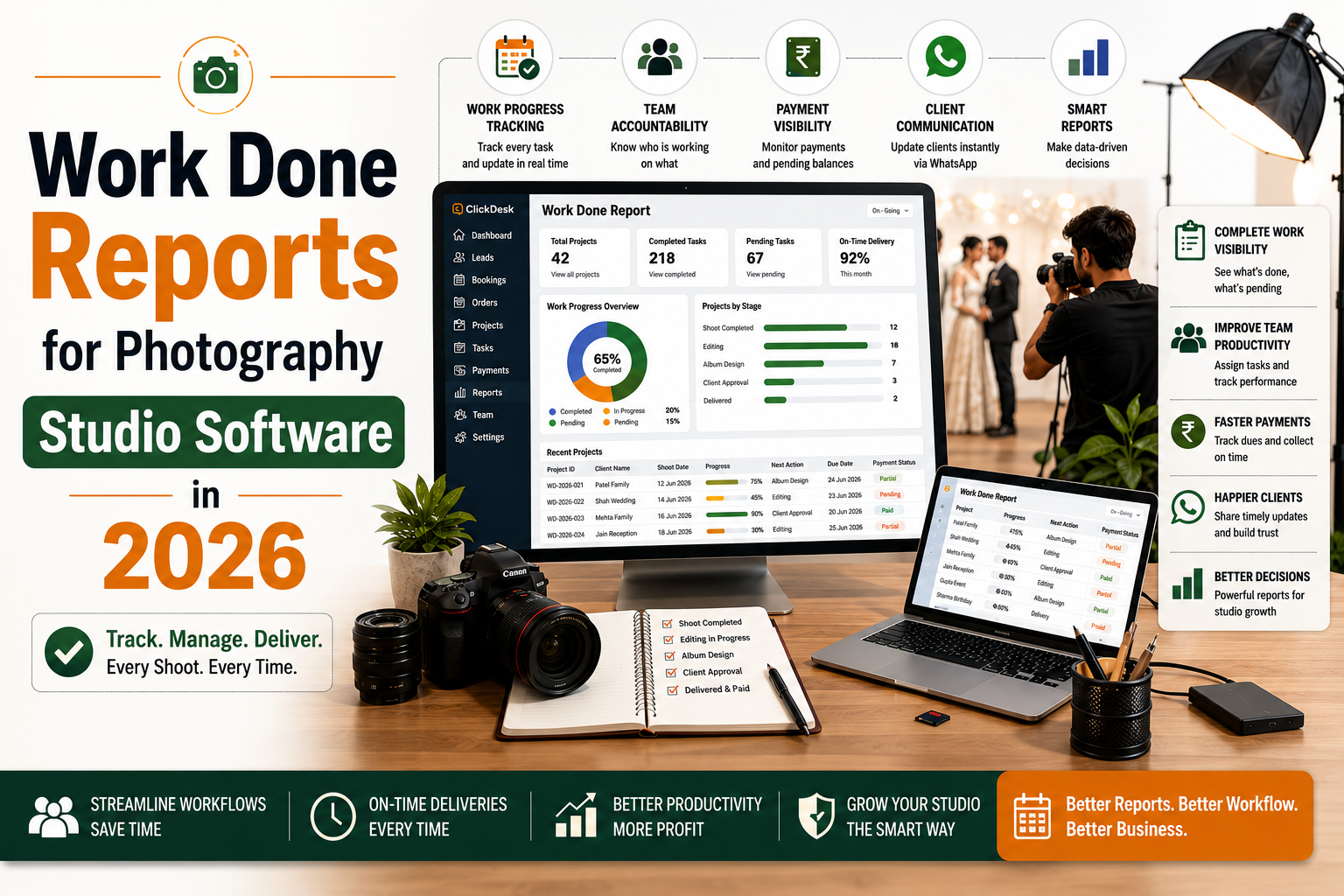
Work Done Reports for Photography Studio Software in 2026
Running a modern studio in India is no longer just about capturing beautiful photographs. It is about managing inquiries, quotations, bookings, multi-day shoots, editor handoffs, album approvals, payments, and delivery commitments across dozens of clients at the same time. That is exactly why work done reports for photography studio software have become one of the most practical tools for growing studios in 2026. Whether you handle weddings in Surat, pre-wedding shoots in Ahmedabad, maternity sessions in Pune, or corporate events in Jaipur, a work done report gives you a clear answer to one question every owner asks daily: what exactly has been completed, what is still pending, and who is responsible for the next step?
Many photography businesses still rely on WhatsApp messages, verbal updates, notebooks, Excel sheets, and memory-based follow-ups. That works only until the studio grows. Once you start handling multiple shoots, multiple editors, multiple delivery dates, and multiple payment milestones, manual tracking becomes risky. Missed deadlines lead to stressed clients. Poor visibility creates team confusion. Delayed album approval blocks final delivery. Untracked balances affect cash flow. A proper work done report solves all of this by turning scattered work updates into one structured, searchable workflow record.
In this guide, we will break down what a work done report means in a photography business, what it should contain, how it improves accountability, how it supports GST billing and payment collection, and how Indian studios can use it to manage wedding, portrait, event, and commercial projects more efficiently. We will also show how ClickDesk fits into this process as a photography studio management software built for Indian studio workflows.
1. What Is a Work Done Report in Photography Studio Software?
A work done report is a structured operational report that records the progress of a project or booking inside a studio management system. In a photography studio, it acts as a real-time summary of what work has been completed, what is pending, who completed it, who is assigned next, and what deadlines or approvals still remain.
Think of it as the operational heartbeat of a booking. If a wedding booking moves from inquiry to quotation, from quotation to order confirmation, from shoot day to culling, from editing to album design, and finally to delivery, the work done report captures each stage of that movement. Instead of depending on memory or checking ten separate chats, the owner can open one report and immediately understand the status of the project.
In simple terms, a work done report answers questions like:
- Has the shoot been completed?
- How many edited photos are ready?
- Is the teaser reel delivered?
- Has album design been shared with the client?
- Which editor is handling the wedding film?
- How much payment has been collected and how much is still due?
- Has the client approved the final album?
- What is the next delivery deadline?
In a well-designed photography studio software, work done reports are not separate from the workflow; they are generated from it. That means the report can pull data from quotations, order conversion, task assignment, payment tracking, WhatsApp communication, and post-production milestones. The result is a report that is not just descriptive, but actionable.
2. Why Photography Studios Need Work Done Reports
A photography studio grows in layers. First comes more bookings. Then comes more team members. Then comes more project overlap, more client communication, more payment stages, more post-production work, and more chances for delays. At that point, a studio does not fail because it lacks photography skill; it struggles because operations become hard to monitor.
2.1 Work done reports create visibility across multiple projects
Wedding and event studios in India rarely manage just one project at a time. A Surat-based studio may be editing one wedding, shooting another, following up on a pre-wedding album, collecting a balance payment for a maternity session, and sharing quotation revisions for a corporate event in the same week. A work done report gives the owner a bird’s-eye view of all active jobs without opening separate folders, spreadsheets, and chat threads.
2.2 They improve accountability across teams
When every stage of work is documented, ownership becomes clear. The shoot team knows what was delivered from the field. The editing team knows what files are ready. The album designer knows whether image selection is final. The accounts team knows whether the next invoice should be raised. Instead of vague statements like “editing is in progress,” the studio can see task-level progress with dates and responsible team members.
2.3 They reduce deadline misses
Delays often happen because pending work is not visible early enough. If album selection is pending for eight days, or if the cinematic teaser has not moved to the video editor, the problem should appear in a report before the client has to ask. Work done reports help studios catch bottlenecks earlier and manage delivery commitments more confidently.
2.4 They support better client communication
Indian clients increasingly expect timely updates. WhatsApp is often the preferred communication channel for booking confirmations, payment reminders, proof sharing, and delivery follow-ups. If your team can see a reliable work done report, they can send accurate updates instead of generic promises. That improves trust and reduces repeated follow-up calls.
2.5 They help owners manage profitability, not just activity
A report should not only show creative progress; it should also show financial progress. If a ₹1,50,000 wedding package has reached final delivery but only ₹95,000 has been collected, the studio needs that visibility before the album leaves the office. Work done reports connect work progress with billing milestones, which helps protect cash flow.
This matters even more in India’s large and highly active wedding economy. According to The Economic Times, the Indian wedding industry is worth around ₹10 lakh crore and hosts roughly 80 lakh to 1 crore weddings annually. For photography studios, that scale means opportunity—but it also means operational pressure during peak seasons when many events overlap. Studios that can track work cleanly are far better positioned to scale than studios that still depend on fragmented updates.
3. What a Photography Studio Work Done Report Should Include
Not every report is useful. A work done report becomes powerful only when it captures the right fields. The goal is to make the report practical for operations, billing, and client service—not just decorative.
3.1 Core client and project details
- Client name and contact number
- Project type: wedding, pre-wedding, maternity, baby shoot, product shoot, corporate event
- Booking ID or order number
- Event date and location
- Package name and total project value
- Assigned relationship manager or coordinator
3.2 Shoot execution details
- Shoot completed or pending
- Number of photographers and videographers assigned
- Raw data received from the field
- Drone footage status if applicable
- Special coverage notes or client requests
3.3 Post-production progress
- Photo culling completed or pending
- Photo editing completed percentage
- Video editing stage
- Teaser reel status
- Highlight film status
- Album design stage
- Client approval status
3.4 Delivery tracking
- Soft copy delivered or pending
- Album print sent or pending
- Frame or other physical product delivery status
- Final handover date
3.5 Payment and billing information
- Total package value
- Advance received
- Milestone-based payment received
- Pending balance
- Invoice generated or pending
- Payment mode: UPI, bank transfer, cash, Razorpay, PayU
3.6 Tax and compliance context
- GST invoice number
- CGST/SGST split for intra-state billing
- IGST if applicable for inter-state clients
- Taxable value and total amount
3.7 Operational remarks
- Pending approvals
- Escalation notes
- Client communication summary
- Next deadline
- Owner remarks or internal follow-up notes
| Section | What to Track | Why It Matters |
|---|---|---|
| Client Details | Name, event, contact, package | Identifies the project and avoids confusion across multiple bookings |
| Shoot Status | Shoot completed, files received, crew assigned | Confirms the project has moved from booking to production |
| Editing Progress | Culling, editing, teaser, film, album design | Tracks post-production and highlights bottlenecks early |
| Payment Tracking | Advance, balance, invoice, gateway status | Prevents delivery before payment and supports cash flow visibility |
| Delivery Status | Soft copy, album, prints, final handover | Ensures final commitments are visible and measurable |
| Tax Details | GST invoice and tax split | Supports compliant billing and cleaner accounts |
4. Manual Tracking vs Software-Based Work Done Reports
Many studios assume they already have a reporting system because they use WhatsApp, Google Sheets, or an office register. But there is a major difference between “having updates somewhere” and “having a reliable work done report.”
| Workflow Area | Manual Tracking | Software-Based Work Done Report |
|---|---|---|
| Project Visibility | Scattered across chats, sheets, and calls | Centralized project-wise status view |
| Task Accountability | Depends on memory and verbal follow-up | Assigned tasks with timestamps and ownership |
| Payment Monitoring | Separate accounting sheet or manual reminder | Linked to booking and delivery milestones |
| Deadline Tracking | Easy to miss during busy season | Visible pending items and next actions |
| Client Updates | Often generic and delayed | Accurate updates based on live project status |
| Owner Control | Requires constant follow-up | Owner can review progress from one dashboard |
| Scalability | Breaks as volume increases | Works better as bookings and teams grow |
The difference becomes obvious during peak wedding months. A studio handling 25 to 40 active bookings cannot afford to ask editors for updates one by one. Nor can it wait until a client asks, “Sir, teaser kab milega?” before checking whether the teaser has even entered the edit queue. Software-based work done reports reduce that dependency on manual follow-up.
5. How Work Done Reports Help Across the Studio Workflow
5.1 During inquiry and quotation stage
A work done report does not have to begin only after the shoot. It can start at the inquiry stage by capturing the status of lead discussion, package sent, quotation shared, follow-up date, and booking confirmation. This is especially useful for high-value wedding inquiries where multiple quotation versions may be sent before the booking closes.
If your studio uses a structured quotation system, the report can show whether the quotation is still open, accepted, revised, or converted into an order. This creates a clean bridge between sales and operations.
5.2 During shoot planning and execution
Once a booking is confirmed, the report becomes the planning record. It can show shoot schedule, venue details, assigned team members, equipment notes, travel requirements, and special client instructions. For multi-day wedding events—Haldi, Sangeet, Wedding, Reception—this is essential because each sub-event may have separate teams and deliverables.
5.3 During post-production
This is where work done reports deliver the biggest operational value. Editing is often the longest stage of a photography workflow, and it is also where studios lose visibility. A good report should show whether raw data is backed up, whether culling is complete, whether color correction has started, whether teaser clips are approved, and whether the album layout is pending client feedback.
5.4 During billing and payment collection
Indian photography studios often collect payments in stages: booking advance, pre-event balance, shoot-day collection, and delivery balance. If the report tracks both work milestones and payment milestones, the accounts team can act at the right time. For example, if final edited files are ready but the last ₹35,000 is pending, the system should show that before the delivery is marked complete.
5.5 During client communication and service
Clients do not want technical explanations. They want clarity. A coordinator using a work done report can confidently say: “Your edited photos are complete, the teaser is in review, and the album design will be shared by Friday.” That is much stronger than saying, “Team se check karke batate hain.”
5.6 During management review
Owners and studio managers need summary reports to monitor operational health. They want to know how many bookings are delayed, which editor has the highest pending load, which projects are ready for billing, and how much revenue is still stuck in undelivered work. Work done reports make those review meetings data-driven instead of assumption-driven.
6. Why Work Done Reports Matter for Indian Photography Studios
Photography businesses in India operate in a uniquely demanding environment. Weddings are often multi-event, multi-location, and multi-team productions. Studios may manage clients from different cities while coordinating local crews, outsourced editors, album printers, and transport arrangements. The need for clear progress reporting is therefore not optional; it is operationally necessary.
6.1 Indian wedding workflows are more layered
A typical Indian wedding project may include pre-wedding, invitation reel, Haldi, Mehendi, Sangeet, Wedding, and Reception coverage. Each event may produce separate photo and video outputs. A work done report helps studios break the project into trackable components instead of treating the entire wedding as one vague “job.”
6.2 Payment collection is often milestone-based
Many studios in cities like Surat, Ahmedabad, Rajkot, Pune, Jaipur, and Indore do not collect the entire amount upfront. They work on advance-plus-balance structures. This makes payment tracking inside the work done report highly valuable because delivery often depends on pending dues.
6.3 GST billing requires cleaner records
Studios issuing GST invoices need stronger alignment between services delivered, invoice milestones, and payment receipts. A work done report creates that operational trail. If a studio needs to reconcile project value, taxable value, and payment collection, having a report linked to order status reduces accounting confusion. It is especially useful when the studio handles CGST/SGST billing for clients within the state and different tax treatment for clients in other states.
6.4 WhatsApp remains the default communication channel
In India, client communication frequently happens on WhatsApp. This is practical and fast, but it can also become chaotic if updates are not backed by a reliable internal status report. A work done report allows the studio team to send accurate reminders, proof requests, and delivery updates without depending on scattered chat history.
6.5 Peak-season volume creates hidden risk
During the wedding season, studios may process bookings worth several lakhs every week. Without structured reporting, small delays snowball. A pending album approval, an editor leave issue, or an uncollected balance can block the final handover of a project worth ₹80,000, ₹2,50,000, or more. Work done reports help the studio identify those blockers before they damage client experience.
The larger context matters too. As India’s wedding economy continues to expand, photography studios are under pressure to operate with more professionalism. Industry reporting and wedding market coverage increasingly point to growing client expectations, larger budgets, and more service coordination. In such a market, better reporting is not just an admin feature—it becomes part of brand reputation.
7. Best Practices for Building Better Work Done Reports
Simply adding a “status” column is not enough. To make work done reports useful, studios should design them around decision-making. The report should help the owner, the coordinator, the editor, and the accounts team all understand what to do next.
7.1 Use stage-based reporting instead of generic status labels
Avoid vague tags like “ongoing” or “in progress.” Instead, break work into meaningful milestones such as raw data received, culling complete, first edit complete, teaser sent, album design shared, final approval received, and delivery done.
7.2 Connect reports to team ownership
Every stage should show who owns the next action. Without ownership, reports become passive records rather than operational tools.
7.3 Include due dates and aging
A pending task is not equally urgent on day one and day ten. Reports should show how long a task has been pending so that managers can prioritize follow-up.
7.4 Link reports to payment milestones
Creative work and payment work should not live in separate universes. If album printing is complete but the final balance is unpaid, the report should make that visible immediately.
7.5 Standardize report structure across all project types
Wedding, maternity, newborn, and product shoots can have different deliverables, but the reporting logic should still be consistent. That makes it easier to train staff and review performance across the business.
7.6 Review reports weekly, not only when something goes wrong
The best studios treat work done reports as a weekly management ritual. They review delayed projects, pending approvals, high-value unpaid jobs, and editor workload before those issues turn into complaints.
8. Sample Work Done Report Format for Photography Studios
Below is a simple example of how a photography studio might structure a work done report for a wedding booking inside software.
| Field | Example Entry |
|---|---|
| Booking ID | WD-2026-074 |
| Client Name | Patel Family |
| Project Type | Wedding + Reception |
| Location | Surat |
| Package Value | ₹1,85,000 |
| Advance Received | ₹75,000 |
| Shoot Status | Completed |
| Raw Data Backup | Completed on 14 June 2026 |
| Photo Culling | Completed |
| Photo Editing | 85% completed |
| Teaser Reel | Shared with client on WhatsApp |
| Album Design | Pending image selection from client |
| Pending Balance | ₹40,000 |
| Next Action | Follow up for album selection and balance payment |
| Assigned Coordinator | Neha |
| Expected Delivery | 30 June 2026 |
This example may look simple, but it already provides more control than most manual systems. Now imagine the same logic scaled across 100 bookings, connected to quotations, invoices, payment tracking, team assignment, and WhatsApp reminders. That is where studio management software becomes transformative.
9. How ClickDesk Helps Photography Studios Manage Work Done Reports
ClickDesk is a cloud-based photography studio management software built for Indian photography studios that want more control over bookings, operations, payments, communication, and reporting. Instead of treating reporting as a separate spreadsheet task, ClickDesk helps bring multiple parts of the studio workflow into one connected system so work done reporting becomes faster, clearer, and more useful.
For a studio owner, the real value of a work done report is not the report itself—it is the confidence that the underlying data is current. If quotations, order status, team tasks, payment records, and post-production updates all live inside one platform, the owner can trust the report. That is the operational advantage ClickDesk is designed to support.
Who ClickDesk is built for
ClickDesk is built for photography businesses that manage recurring bookings and need structure beyond spreadsheets. This includes wedding photography studios, pre-wedding specialists, baby and maternity photographers, event studios, portrait teams, and growing creative businesses that coordinate multiple staff members and delivery timelines.
India-specific ClickDesk features that support work done reporting
- Quotation workflows for photography packages, event coverage plans, and client approvals
- Order conversion tools that move confirmed quotations into active studio jobs
- Team assignment features for photographers, editors, coordinators, and designers
- Payment tracking with clear visibility into advance, balance, and pending dues
- Post-production workflow tracking for editing, album design, and delivery stages
- WhatsApp integration for smoother client communication and follow-up reminders
- Reporting tools that help studio owners monitor booking status, work progress, and financial movement
- Cloud access for studio owners who want to review updates from office, home, or while traveling between shoots
- Support for Indian billing workflows, including GST-friendly operational records
- Useful for studios in high-volume markets such as Surat, Ahmedabad, Pune, Jaipur, and beyond
If your studio is trying to reduce missed follow-ups, improve team visibility, and manage active bookings more confidently, it makes sense to explore a workflow system rather than keep patching manual processes. You can review ClickDesk’s best photography studio management software features, browse the full ClickDesk photography business blog, or understand more about the team behind the platform on the ClickDesk about page.
Work done reports become even more useful when they are connected to the rest of your studio system. That is why related workflow modules matter too. Depending on how your studio operates, you may also want to explore quotation management for photography studios, order conversion tools for confirmed bookings, team management for photographers and editors, payment tracking for studio balances, post-production workflow management, WhatsApp integration for client communication, and reporting tools for photography studio operations.
If you are evaluating software options, you can also compare features and plan value directly on the ClickDesk pricing page for photography studio software. And if you want to discuss your workflow, team structure, or current reporting problems, you can contact ClickDesk for a product walkthrough.
10. Final Thoughts: Work Done Reports Are Not Just Reports—They Are Workflow Control
Photography studios do not lose time only in shooting or editing; they lose time in confusion. A missing update, a forgotten payment follow-up, an unassigned album revision, or an unclear delivery date can quietly slow down the entire business. Work done reports for photography studio software solve this by giving the studio a live operational picture of every booking. They improve visibility, accountability, billing control, and client communication all at once.
For Indian studios handling weddings, portraits, events, and growing post-production workloads, the need is even greater. As project volume rises, relying on memory and scattered chats becomes expensive. A structured work done report turns daily studio operations into a manageable system—one where owners know what is complete, what is pending, and what needs attention next.
If your studio is still managing progress updates manually, now is the right time to move to a workflow built for photography businesses. Explore ClickDesk, review the features that matter to your team, and see how connected reporting can improve your studio’s speed, clarity, and delivery control. Start your free ClickDesk trial today →
Frequently Asked Questions
1. What is a work done report in photography studio software?
A work done report is a project progress report that tracks completed tasks, pending activities, assigned team members, payment milestones, editing stages, and delivery status for each booking. In photography studio software, it helps the owner and team understand the exact state of a project without checking multiple tools.
2. Why are work done reports important for wedding photography studios?
Wedding photography studios handle multi-event projects, multiple team members, large file workflows, and stage-wise payments. A work done report keeps track of each milestone—from shoot completion to album delivery—so the studio can reduce delays, improve client communication, and collect payments on time.
3. What should be included in a photography studio work done report?
A good work done report should include client details, project type, package value, shoot status, editing progress, album design status, delivery milestones, assigned staff, pending tasks, invoice status, GST-related billing references, and pending payment amounts.
4. Can ClickDesk help create work done reports for Indian photography studios?
Yes. ClickDesk is designed for Indian photography studios and supports workflows such as quotation management, order conversion, team assignment, payment tracking, post-production tracking, WhatsApp communication, and reporting tools. These features help studios maintain structured work done reporting across active bookings.
5. How do work done reports support GST billing and payment tracking?
Work done reports create a clear record of service completion, invoice milestones, and payment collection. This makes it easier for photography studios to match work progress with GST invoices, pending balances, and tax-related records such as CGST and SGST where applicable.
6. Are work done reports useful for small photography studios too?
Absolutely. Even a small studio benefits from better visibility into pending edits, client follow-ups, payment collection, and delivery schedules. In fact, early adoption helps small studios build stronger systems before project volume increases.
References and Useful Resources
- ClickDesk homepage
- Cloud-based photography studio management software guide
- Photography software blog resources
- Harvard Business Review on data-driven decision making
- Forbes resources on business automation and operational efficiency
- Statista overview of marriages and wedding market data in India
- Economic Times report on the Indian wedding economy
- GST portal for tax and invoicing reference
- McKinsey insights on productivity, operations, and workflow efficiency