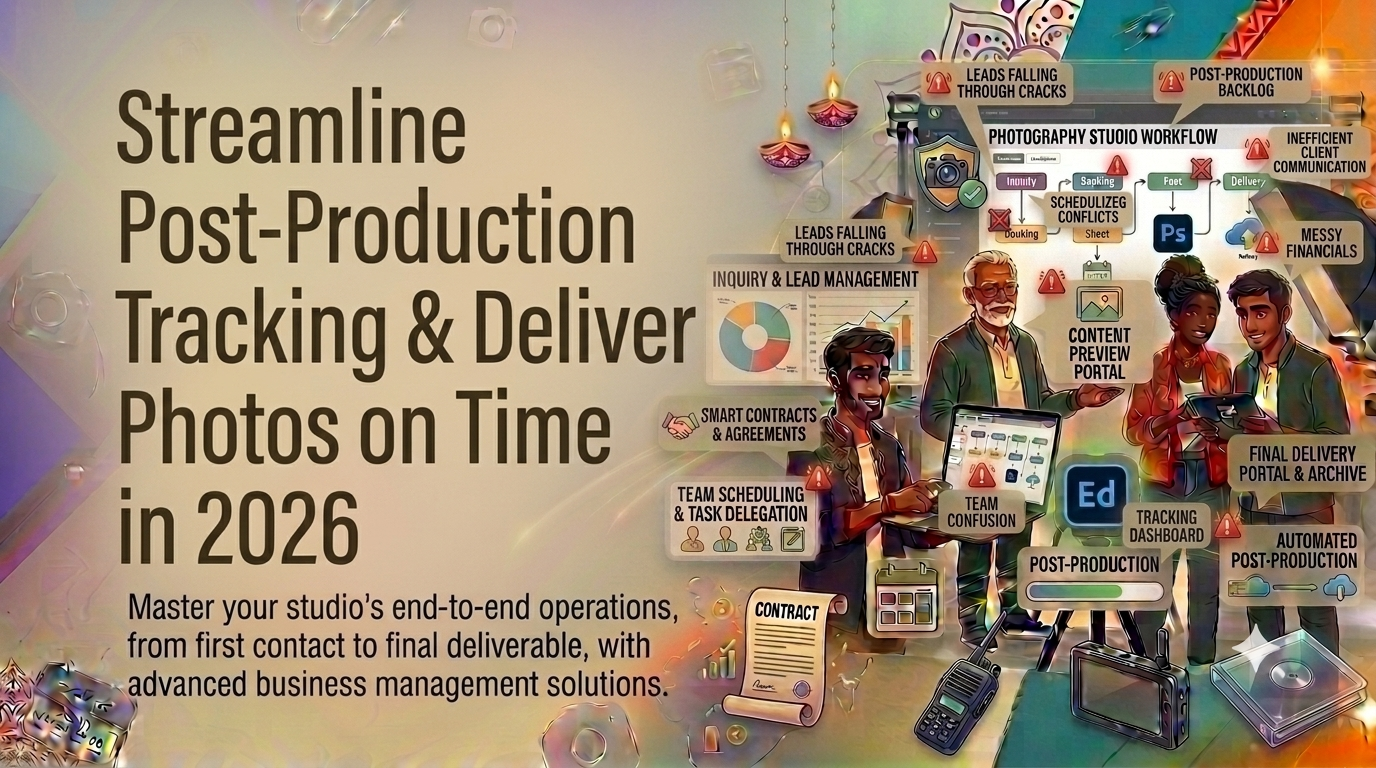
Streamline Post-Production Tracking & Deliver Photos on Time in 2026
The Growing Post-Production Crisis in Indian Wedding Photography
Running a premium wedding photography business in India is an exhilarating journey, yet it carries an immense logistical burden. During peak wedding months—when auspicious dates block out calendars across regions like Surat, Ahmedabad, Pune, and Jaipur—studios routinely shoot multiple massive events in a single week. A standard three-day grand Indian wedding, spanning from high-energy Mehndi and Sangeet ceremonies to the emotional Pheras and grand Reception, easily generates anywhere from 3,000 to over 8,000 raw frames per camera team. When you multiply that volume by five or ten concurrent clients, the sheer storage volume scale becomes staggeringly evident.
For the modern creative entrepreneur, the real test of business sustainability does not happen on the chaotic ballroom floor or amidst gorgeous outdoor portraits; it unfolds silently at the editing desk. Learning how to streamline post-production tracking and deliver client photos on time has transformed from an operational advantage into an absolute prerequisite for survival. Without clear structural control over your post-event workflow, the creative joy of photography quickly transforms into an exhausting battle against massive backlogs, frantic late-night client calls, broken promises, and damaged brand equity.
The consumer landscape in India has evolved rapidly. Driven by the swift expansion of digital ecosystems and high-speed infrastructure, modern couples expect lightning-fast turnarounds without a single compromise on image quality. According to extensive market data compiled in reports analyzing digital consumer behaviors by global consulting authorities like McKinsey & Company, Indian consumers across retail, entertainment, and customized service spaces place a massive premium on operational transparency and absolute punctuality. When couples pay premium packages running into multiple lakhs of rupees, they expect an organized, stress-free delivery process. Studios that consistently fail to deliver their final high-resolution assets on time suffer catastrophic blows to their referral pipelines, which remain the lifeblood of the premium Indian event market.
Furthermore, post-production stagnation is not merely a reputation hazard; it is an immediate financial drain. Unfinished assignments lock up critical final payments, leaving business owners with severe cash flow deficits precisely when they need to pay second shooters, lighting assistants, equipment rental vendors, and laboratory printers. Resolving this deep-seated issue requires an objective, analytical look at the operational mechanics of your post-production workflow, identifying exactly where bottlenecks occur, and deploying highly automated solutions designed to systematically clear the hurdles.
Deconstructing the Post-Production Pipeline: Milestones That Matter
To establish control over your studio's operational timeline, you must treat post-production not as a singular, monolithic chunk of creative work, but as a series of highly predictable, strictly monitored sub-stages. When an assignment lacks detailed intermediate checkpoints, tracking its progress becomes completely impossible. If a studio owner asks an editor about the status of a specific wedding and receives a vague answer like "I am working on it," true visibility is nonexistent. By breaking down the process into clearly defined, immutable milestones, you gain the ability to pinpoint exact delays and reallocate internal resources before a delivery deadline is irreversibly missed.
An effective, high-throughput photography workflow typically moves through six distinct phases, each requiring explicit tracking metrics:
- Data Ingestion & Redundant Backup: Transferring multi-terabyte raw assets from high-speed memory cards directly onto localized high-performance NAS drives and secure, parallel cloud storage configurations within 12 hours of event conclusion.
- Initial Raw Selection (Culling): Trimming down thousands of duplicate, out-of-focus, or blinking shots to a curated, cohesive collection of master images representing the absolute best moments of the wedding.
- Color Correction & Creative Grading: Adjusting exposure levels, white balance parameters, and color balances across highly varied lighting conditions—ranging from natural sunlight to challenging, intensely saturated indoor event lights.
- High-End Portrait Retouching: Applying advanced skin cleanups, distracting element removals, and precise dodging and burning to couple portraits and formal family groupings.
- Client Review & Selection Validation: Presenting the polished collection to the family via a secure digital layout for them to select their favorite images for physical heirloom albums.
- Album Design & Final Delivery Production: Designing custom layouts, sending proofing drafts for final approval, coordinating print production with premium labs, and rendering high-resolution digital galleries.
To help visualize how time balances across these individual components, consider the baseline structural timeline mapped out below for a standard three-day Indian wedding assignment:
| Workflow Stage Name | Target Duration (Days) | Primary Operational Owner | Critical Dependency Factor |
|---|---|---|---|
| Data Ingestion & Backup Verification | 1 Day | Digital Asset Manager / Lead DIT | Card integrity, multi-drive storage capacity |
| Master Selection & Culling Cycle | 5 Days | Lead Creative Editor / Culling Team | Strict narrative framework adherence |
| Primary Color Correction & Grading | 10 Days | Colorist / Senior Retoucher | Calibrated monitor profiles, lighting consistency |
| High-End Portrait Fine Retouching | 7 Days | Specialist Retoucher / External Studio | Client skin profile preferences |
| Client Selection Phase & Feedback Window | 14 Days | Client Coordination Manager | Client response promptness, interactive portal ease |
| Album Layout Design & Lab Printing | 10 Days | Album Designer / Print Vendor | Lab production queues, courier shipping speeds |
By mapping out these specific metrics, your management team can instantly detect if the culling phase for a particular client has taken 12 days instead of the allocated 5 days. Catching this variance early allows you to make operational corrections, keeping your final commitment date fully intact without resorting to panicked, low-quality rush work at the very end.
Techniques to Speed Up Raw Sorting, Image Selection, and Client Culling
The single largest time drain in the entire post-production lifecycle is almost always the initial sorting phase, commonly known within the creative community as culling. Sifting through thousands of raw images to eliminate blurry shots, test exposures, and duplicate candid frames can completely stall an editing team's momentum. If your editors spend weeks just looking at identical images, your turnaround times will naturally balloon. Accelerating this specific phase requires a combination of modern software tools and disciplined sorting methodologies.
First, studios must implement a rigorous two-pass culling strategy. During the first pass, the editor should focus strictly on rejection—rapidly marking out obvious technical failures like missed focus, closed eyes, unflattering angles, or incorrect flash triggers. Editors should not debate the artistic merits of an image during this initial pass; they must simply clear out the technical clutter. The second pass then focuses on selection, where the editor builds a powerful, structured narrative of the wedding day by choosing the absolute best expressions and compositions from the remaining clean assets. Transitioning to dedicated AI-driven culling utilities can also speed up this process significantly, as these tools can group similar images and detect closed eyes in seconds, allowing human editors to focus their energy entirely on creative storytelling decisions.
Once the internal selection is complete, the next major hurdle is the client selection process. Many Indian studios run into major delays here. When a studio sends a disorganized digital folder or a physical drive filled with thousands of unindexed images to a client family, the sheer volume can easily overwhelm them. The couple, often busy returning to work or setting up their new home, ends up putting off the selection task for months. This delay breaks your post-production momentum and leaves old projects hanging over your schedule well into the next shooting season.
To fix this bottleneck, successful studios use structured, highly interactive online gallery portals that simplify the selection experience for the client. Instead of dumping the entire event into a single folder, group the images into clear, chronological tabs, such as "Haldi Ceremony," "Sangeet Night," and "The Wedding Rituals." You should also set up automated, friendly follow-up notifications. By using an integrated WhatsApp integration for photography studio workflows, you can automatically send gentle, direct reminders to the couple’s phones, keeping the selection process top-of-mind and moving smoothly toward completion.
Managing Freelance Editors, Retouchers, and Internal Design Teams
As your photography studio scales up from handling 15 weddings a year to managing 60 or more, relying solely on your internal team for editing becomes physically impossible. Scaling up requires building a reliable ecosystem of freelance editors, outsourced retouching boutique agencies, and dedicated album designers. However, expanding your team introduces a new challenge: maintaining absolute consistency in style, color accuracy, and delivery times across a distributed workforce.
Managing external creative talent successfully requires clear standardization. You cannot simply hand over a hard drive of raw files to a freelance editor and expect perfect results without setting clear boundaries. You must provide them with clear, comprehensive style guides. These guides should include calibrated color profiles, detailed Adobe Lightroom catalog presets tailored for specific venue types, clear instructions on grain structure, and precise rules for cropping and skin retouching benchmarks. Additionally, every outsourced project must be assigned clear internal milestones with built-in time buffers. If a client is promised their final images within 45 days, your agreement with the freelance editor should require a full delivery within 25 days. This 20-day buffer gives your senior editors plenty of room to catch any quality issues, manage necessary revisions, and handle final polishes without risking a late delivery to the client.
To effectively evaluate your resource allocation strategy, consider the pros and cons outlined in the comparison table below:
| Operational Vector | In-House Production Team Model | Outsourced/Freelance Editor Model |
|---|---|---|
| Quality Control | Exceptionally high; immediate, real-time oversight and direct guidance. | Variable; requires robust, clear style guidelines and strict incoming QC checks. |
| Financial Structure | Fixed monthly salary overhead, regardless of seasonal volume drops. | Variable cost per event; perfectly mirrors studio revenue fluctuations. |
| Scalability Potential | Limited by physical seating space and internal hiring speeds. | Virtually infinite; easily scale up to handle peak wedding months. |
| Turnaround Speeds | Can bottleneck fast during peak Muhurat dates. | Fast, parallel processing paths across multiple vendors. |
| Communication Friction | Zero; immediate verbal collaboration within the physical studio space. | Moderate to high; requires structured software systems to stay aligned. |
Maintaining clear oversight over this distributed network requires a central tracking hub. Trying to track these moving parts via scattered email threads, confusing messaging groups, and text messages eventually leads to dropped details and missed deadlines. You need a unified management portal where you can assign specific tasks to individual editors, track real-time progress against firm deadlines, and monitor every single project asset from a single dashboard. Utilizing dedicated team management for photography studio platforms gives your leadership team full operational visibility, ensuring that no freelance designer or external retoucher falls behind schedule and jeopardizes your client delivery timeline.
How Communication Bottlenecks Derail Delivery Deadlines
A significant portion of post-production delays stem not from technical issues or slow editing, but from breakdowns in clear communication. The lifecycle of a wedding project involves dozens of detailed touchpoints between the studio team and the client family. These include sending initial highlight reels, gathering song choices for the cinematic film, handling specific retouching requests, and managing print layouts for physical albums. When these communications become scattered across multiple different channels, miscommunications and long delays are practically guaranteed.
Consider a very common scenario for an Indian photography studio: a client texts a specific photo retouching request via WhatsApp, the parent calls the lead photographer to change an album photo, and the groom sends an email with song selections for the video trailer. If these requests are not centralized into a single tracking system, they easily get lost in the daily shuffle. An editor might finish an entire album layout using the original asset list, only to discover weeks later that the client's updated choices were buried in an unread messaging thread. The result is extensive, frustrating re-work, wasted designer hours, growing client frustration, and missed delivery deadlines.
To prevent these costly communication failures, studios must build a single, standardized channel for all client interactions. Clients should be guided to submit all feedback, image selections, and revision requests through a central, secure client portal. This ensures every piece of feedback is automatically logged, time-stamped, and linked directly to the specific project file. If your studio leverages an integrated order conversion for photography studio framework, your team can instantly see the exact history of client requests, agreed-upon terms, and past approvals. Keeping everyone on the same page eliminates confusion, keeps your editing team focused on accurate data, and ensures your post-production workflow moves forward smoothly without unnecessary delays.
Financial Implications of Late Deliveries and Project Stagnation
Many photography studio owners view post-production delays primarily as a customer service issue. In reality, slow delivery workflows represent a direct threat to your studio's financial health and bottom-line profitability. In the professional Indian wedding industry, payment milestones are typically structured across the project lifecycle: a booking deposit, an advance payment on the first day of shooting, and a final retention balance—often ranging between 10% to 20% of the total contract value—payable only upon the successful delivery of the final physical albums and digital assets.
When your post-production pipeline stalls, those final retention balances remain completely locked up. If a studio is handling 30 projects a year with an average booking value of ₹2,500,000, having the final 20% delayed means leaving ₹15 lakhs of hard-earned revenue sitting out of reach. This cash flow crunch can make it difficult to cover fixed operational costs, update studio gear, or launch marketing campaigns for the next season. According to small business cash flow data published by the Harvard Business Review, consistent delays in accounts receivable collection are a leading driver of operational failure for service-oriented creative firms globally.
Beyond locked-up retention balances, operational inefficiency creates significant hidden costs. When an assignment drags on for six to nine months, your staff spends hours answering follow-up calls, tracking down missing files, and making endless minor revisions. These extra hours eat directly into the project's profitability. A project that would have yielded a excellent 40% net profit margin if completed in 45 days can see that margin drop significantly if it drags on for a year, consuming valuable administrative time and studio energy. Punctual workflows, supported by reliable payment tracking for photography studio management tools, protect your profit margins and ensure your business generates consistent, predictable cash flow all year round.
Transitioning from Messy Spreadsheets to Unified Tracking Systems
When you are first launching your photography studio, managing your clients and tracking tasks on a basic spreadsheet or a wall-mounted whiteboard can feel like enough. But as your business expands, these manual tracking methods quickly fall apart. Spreadsheets require manual updates, don't scale well, and cannot automatically alert your team to problems. They cannot send automated follow-up messages to a client who is late selecting their photos, they don't integrate with your raw file storage, and they cannot give your editing team real-time updates on changing deadlines. Relying on manual data entry introduces human error, leading to missed deadlines and forgotten tasks during the hectic wedding season.
True operational efficiency requires moving away from fragmented tools and adopting a single, unified studio management ecosystem. A dedicated platform connects every stage of your business—from the initial client inquiry and quotation generation to detailed post-production tracking, automated invoice billing, and final asset delivery. This structural clarity ensures your team always knows exactly what task needs attention next, eliminating confusion and keeping your workflow moving forward smoothly.
Furthermore, upgrading your studio infrastructure provides invaluable business insights. Instead of guessing at your team's capacity or workflow speed, a centralized system gives you clear, data-driven performance metrics. Advanced reporting tools for photography studio analytics let you track exactly how long each editing phase takes, measure the efficiency of your freelance partners, and identify exactly where projects tend to stall. Armed with this clear operational data, you can make informed decisions to optimize your workflows, eliminate waste, scale up your studio's capacity, and ensure your team consistently delivers beautiful, high-quality work on time, every time.
Transform Your Studio Operations with ClickDesk
ClickDesk (clickdesk.in) is an all-in-one, highly advanced photography studio management software built in India, specifically engineered to meet the unique operational needs of Indian photography and cinematography ventures. Whether you are running a premium boutique studio in Surat or managing a large, multi-city creative team across Mumbai, Delhi, and Bangalore, ClickDesk provides a single, unified workspace that streamlines your entire operational pipeline—eliminating chaotic manual processes and empowering your business to deliver exceptional client experiences at scale.
Designed from the ground up to handle the fast-paced realities of the Indian wedding and commercial event landscape, ClickDesk eliminates the need for fragmented tools by centralizing your workflows into a single, intuitive platform. From tracking multi-day event milestones and managing complex client feedback to handling automated billing compliance, ClickDesk handles your studio's administrative heavy lifting, freeing your creative team to focus completely on what they do best: capturing breathtaking, unforgettable visual stories.
- Localized GST-Compliant Billing Architecture: Effortlessly generate accurate professional invoices that automatically compute perfect CGST, SGST, and IGST breakdowns, perfectly aligned with current national tax codes.
- Intelligent Indian WhatsApp API Integrations: Shift away from ignored emails by automatically sending dynamic booking confirmations, polite payment reminders, and instant photo selection alerts directly to your clients' preferred messaging app.
- End-to-End Post-Production & Milestone Tracking: Monitor every stage of your editing pipeline with precision, easily tracking raw data ingestion, creative color grading, high-end portrait retouching, and final album design.
- Advanced Quotation & Contract Management: Create polished, itemized multi-day event proposals and capture binding digital signatures instantly, accelerating your client booking cycles.
- Integrated Payment Gateway Support: Connect seamlessly with trusted national platforms like Razorpay and PayU to provide clients with secure, instant payment options including UPI, net banking, and local credit cards.
- Comprehensive Team & Resource Allocation: Effortlessly assign lead photographers, second shooters, lighting assistants, and freelance editors to specific event dates, eliminating scheduling conflicts during peak wedding seasons.
Investing in your studio's administrative infrastructure is the key to unlocking sustainable business growth. By replacing messy, manual spreadsheets with a unified tracking platform, you gain absolute clarity across your workflows, protect your valuable profit margins, and build a powerful reputation for flawless, on-time delivery. Explore the complete, rich feature set by visiting the comprehensive guide to the best feature for photography studio management software solutions, and review flexible deployment packages tailored for growing creative teams by checking out the transparent ClickDesk pricing plans today.
Ready to break free from stressful editing backlogs, eliminate messy spreadsheets, and build a flawless reputation for on-time delivery that sets your studio apart? Elevate your photography business operations, delight your client families with automated updates, and regain absolute control over your workflows today. Start your free ClickDesk trial today →
Frequently Asked Questions
How long should post-production tracking take for a standard three-day Indian wedding?
A standard three-day Indian wedding yields thousands of raw frames across multiple cameras. The ideal post-production tracking pipeline should allocate 5 to 7 days for initial raw backup and automated sorting, 10 days for client selection (culling verification), 15 to 20 days for core color grading and retouching, and 7 days for album designing. Total delivery should comfortably sit between 45 to 60 days post-event. Utilizing specialized post-production for photography studio tools keeps teams accountable throughout this period.
What is the best way to handle chronic client delays during the photo selection process?
Client-induced delays are the leading cause of late final deliveries in India. To combat this, set automated, automated reminders via platforms like WhatsApp. Establish clear milestones in your initial digital contract—such as a 30-day window for photo selection—after which the delivery date dynamically shifts. Studio management tools like ClickDesk allow you to track exactly when a client views their gallery, enabling you to trigger polite automated alerts.
Should I manage my post-production tracking via traditional spreadsheets or software?
While spreadsheets like Excel or Google Sheets are virtually free, they break down rapidly when managing multiple concurrent wedding projects during peak season. They lack automatic status updates, automated WhatsApp notifications, and direct linkages to client files or invoices. Investing in robust photography studio management software provides live tracking, task delegation, automated client follow-ups, and systemic workflow transparency that spreadsheets simply cannot replicate.
How does specialized studio management software improve profitability for Indian photographers?
Dedicated software like ClickDesk helps eliminate human error, reduces administrative labor overhead, minimizes missing invoice collection leaks, and automatically applies localized compliance parameters like CGST and SGST. By shrinking the operational lifecycle of an assignment, your internal team can handle up to 40% more bookings annually without needing to hire additional staff.
How can I calculate realistic delivery milestones for my freelance editors?
Calculate freelance editor milestones by establishing a baseline throughput rate—for example, 150 retouched images per day. Add a mandatory 25% administrative buffer to accommodate inevitable internet disruptions, regional power cuts, or revisions. Track these benchmarks explicitly using team management modules to ensure external vendors do not derail your primary client agreement schedules.