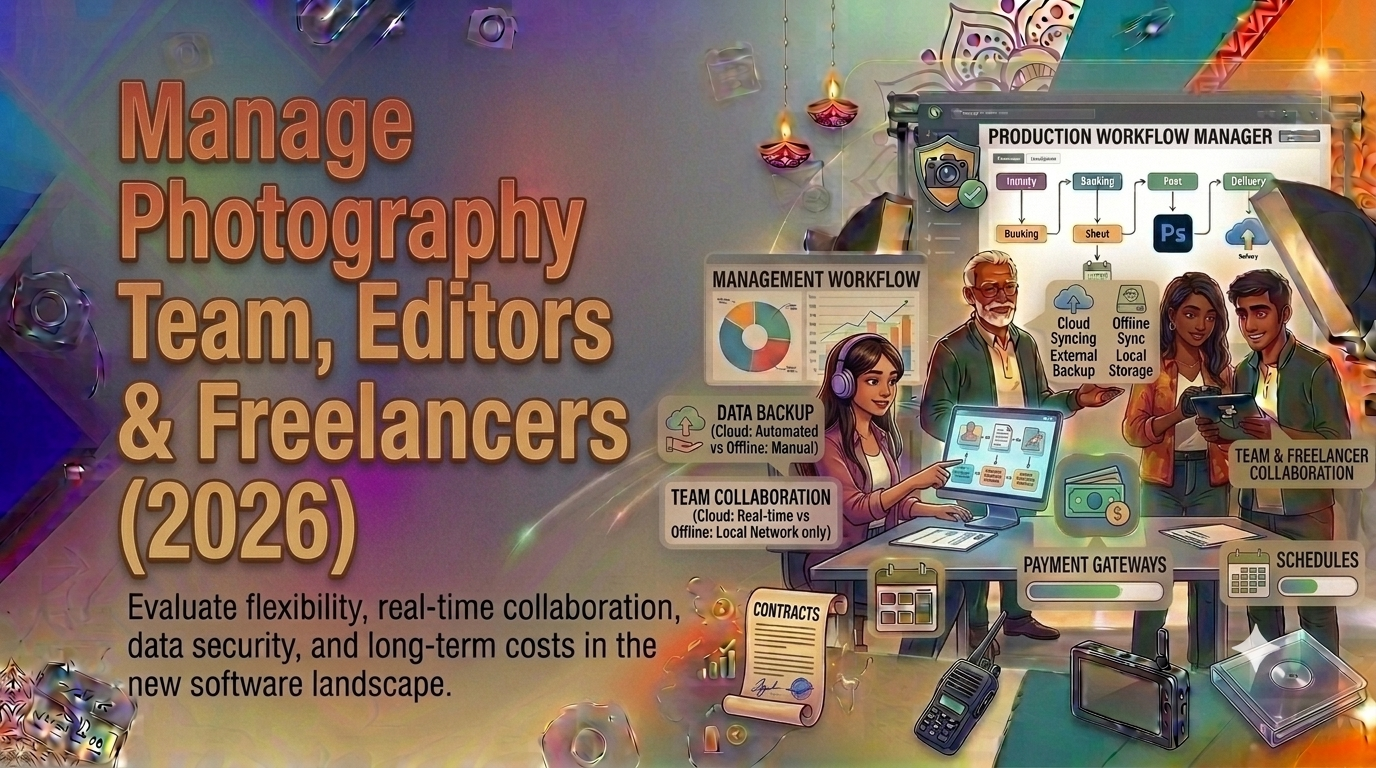
How to Manage Photography Team, Editors & Freelancers in 2026
Introduction: The Scaling Nightmare of Indian Photography Studios
Running a successful creative enterprise in India is an exhilarating journey, but learning how to manage photography team, editors, and freelancers seamlessly is often the single biggest hurdle preventing studio owners from scaling beyond a local footprint. When you transition from a single-photographer setup to managing 15 to 30 multi-day destination weddings during peak wedding seasons (such as the intense Dev Uthani Gyaras rush), operational control can degrade rapidly. Missing edit deadlines, double-booked freelance cinematographers, unorganized RAW media, and untracked freelance payouts turn creative passion into administrative chaos.
According to recent market research on creative service sectors published by Statista, the Indian wedding and event ecosystem handles multi-billion-dollar transaction volumes annually, yet over 68% of small-to-midsize photography studios struggle with post-production bottlenecks and team retention issues. Studio directors in cities like Surat, Ahmedabad, Pune, Jaipur, and Hyderabad find themselves acting as full-time firefighters—chasing editors on WhatsApp, manually cross-checking bank transfers via UPI, and resolving disputes over missing shoot gear.
To build a predictable, highly profitable, and reputable brand, you must move away from informal verbal agreements and messy spreadsheet trackers. This comprehensive guide outlines the exact systems, standard operating procedures (SOPs), legal structures, and digital tools required to coordinate your on-field crew and post-production staff seamlessly. You can also explore our detailed guide on team management for photography studio setups to understand core delegation techniques.
Building the Core Structure: In-House Staff vs. Freelance Operators
A resilient photography enterprise balances fixed operational costs with elastic production capacity. Attempting to keep every camera operator, drone pilot, lighting assistant, and video editor on a full-time monthly payroll severely impacts cash flow during quiet monsoon months. Conversely, relying 100% on freelancers exposes your brand to last-minute shoot cancellations and inconsistent artistic quality control.
Defining Core In-House Roles
Your internal core team represents your brand identity, operating standards, and client relations unit. These team members handle high-touch interactions, client consultations, lead creative direction, and critical operational assets.
- Lead Creative Director / Senior Photographer: Oversees visual language, manages primary client communications on shoot days, and handles high-end portraiture.
- Studio Operations Manager: Coordinates schedules, issues formal quotes using a system like quotation management for photography studio workflows, and handles equipment dispatch.
- Senior Post-Production Manager: Controls color profiles, approves final album layouts, performs final video edits, and archives source material.
Leveraging On-Demand Freelance Capacity
Freelancers provide specialized expertise and scale operational capacity during busy periods without expanding permanent overhead costs. Ideal freelance roles include candid cinematographers, traditional videographers, gimbal operators, specialized drone pilots, assistant light men, and secondary culling editors.
Studies on operational workforce strategy from the Harvard Business Review highlight that hybrid workforce models achieve 32% higher operational flexibility when governance workflows are formalized digitally. To assess how your studio structures its internal vs. external labor split, evaluate the operational matrix below:
| Operational Metric | In-House Permanent Staff | Freelance On-Demand Crew |
|---|---|---|
| Cost Structure | Fixed monthly salary + PF/Incentives | Variable day-rate (Per Shift / Per Event) |
| Brand Loyalty & Consistency | Very High — aligned with studio style | Variable — requires strict briefing & SOPs |
| Scalability in Peak Season | Low — constrained by headcount | Very High — flexible capacity expansion |
| Management Overhead | Low administrative overhead once trained | High vetting, contract, and tracking overhead |
| Equipment Reliance | Uses studio-owned gear & workstations | Brings specialized personal gear (FX3, Drones) |
Sourcing, Onboarding, and Retaining High-Performing Freelancers
The freelance market across tier-1 and tier-2 Indian cities is dynamic. Top-tier traditional videographers and candid photographers book out months in advance during peak shubh muhurat wedding windows. Securing reliable, elite talent requires structured recruitment processes rather than last-minute calls.
Systematic Vetting and Onboarding
Never hire a freelancer based solely on an Instagram grid or a curated portfolio reel. Portfolios often feature work heavily edited by external studios. Follow this three-step vetting protocol:
- RAW Data Review: Request unedited RAW video clips and un-culled camera cards from a complete real-world assignment to evaluate framing consistency, exposure control, and focus accuracy.
- Paid Trial Shoot: Deploy candidate freelancers on smaller assignments (e.g., pre-wedding shoots, corporate events, or birthday parties) alongside a senior internal crew member to evaluate punctuality, hygiene, body language, and team etiquette.
- Standardized Onboarding Packet: Provide selected freelancers with a complete guide detailing attire standards (e.g., all-black studio dress codes), client interaction rules, gear expectations, and camera sync settings.
Retaining top-tier freelance talent comes down to prompt payments and transparent processes. Pair structured payouts with payment tracking for photography studio tools to ensure on-time vendor settlements, building long-term loyalty among top creative talent.
Streamlining Post-Production Workflows & Editing Pipelines
Post-production is frequently where photography studio profitability breaks down. Delays in raw culling, color grading, album design selection, and client video revisions lock up capital and delay final client payment collection.
Establishing Standard Operating Procedures (SOPs) for File Ingest
Implement strict data handling procedures from the moment cards leave the camera on-site:
- Dual-Card Backup Rule: Never format camera cards on location. Maintain dual-card slot recording (Slot 1 RAW, Slot 2 RAW/Backup) on all primary bodies.
- 3-2-1 Archiving Strategy: Keep 3 copies of all project files across 2 different storage media types (e.g., local RAID storage and offsite cloud storage), with 1 copy stored offsite.
- Standardized Directory Naming: Use clean, consistent folder naming conventions across all storage drives:
YYYYMMDD_ClientName_Event_Location (e.g., 20261125_RohanAnanya_Sangeet_Jaipur)
Managing In-House & Outsources Post-Production Editors
Whether you work with internal editors or external post-production houses, setting clear tracking milestones prevents project stalls. Modern software solutions like ClickDesk's post-production for photography studio module allow managers to assign milestone deadlines (e.g., Culling, Color Correction, Teaser Cut, Album Layout, Final Render) with automatic status updates.
| Workflow Stage | Responsible Party | Target SLA (Post-Event) | Deliverable Output |
|---|---|---|---|
| Data Offloading & Backup | Data Manager / Lead Assistant | Within 12 Hours | Verified checksum backup on local RAID drive |
| Teaser Photo Selection & Edit | Lead Colorist / Senior Editor | Within 48 Hours | 25-30 high-res edited photos for social sharing |
| RAW Image Culling | Junior Editor / Freelance Culler | 5 Business Days | Filtered Smart Preview catalog for client selection |
| Reel / Teaser Video Edit | Cinematographer / Reel Editor | 7 Business Days | 1-minute vertical reel (9:16) with trending audio |
| Full Wedding Film & Album Layout | Senior Video & Album Designer | 21 Business Days | First draft video edit link & digital album proofing link |
Analysis on business process optimization from McKinsey & Company reveals that setting clear SLA-backed workflow stages improves turn-around times by up to 40% while reducing client management inquiries.
Centralizing Communication & Task Assignment via Automation
Relying on fragmented WhatsApp groups, personal text chats, and informal phone calls inevitably leads to miscommunication. Details like venue location changes, specific client requests, or shot lists get buried in busy chat threads.
Eliminating Information Silos
Implement centralized communication channels where all shoot briefs, client preferences, contact details, venue locations, and schedule timelines are linked directly to specific project profiles. Integrating specialized features like WhatsApp integration for photography studio workflows enables automated reminders sent directly to team members and clients without manual overhead.
Automated communication workflows provide several key operational benefits:
- Automated Call Sheets: Automatically dispatch digital call sheets 24 hours before a shoot containing GPS links, team role breakdown, client contact numbers, and timeline schedules.
- Task Completion Tracking: Receive real-time notifications when freelancers or editors finish specific project milestones, keeping post-production pipelines moving smoothly.
- Direct Lead Conversion: Streamline sales-to-production handoffs by linking team workflows with your order conversion for photography studio systems.
Legal Contracts, GST Billing, and Contractor Financial Management
Financial management and legal safeguards form the backbone of a sustainable studio enterprise. As your business scales into multi-lakh turnover brackets, maintaining strict tax compliance and formal legal agreements becomes essential.
Essential Legal Clauses for Freelancers and Staff
Protect your intellectual property, client relationships, and business reputation with standardized contracts:
- Work-for-Hire & Copyright Transfer: Explicitly state in contractor agreements that all creative output—including unedited RAW images, video footage, and audio tracks—remains the exclusive intellectual property of your studio.
- Non-Solicitation & Non-Compete Clauses: Prevent freelance crew members from directly soliciting your studio's clients, distributing personal business cards on shoot locations, or taking side bookings through contacts made on your assignments.
- Data Protection & Confidentiality: Prohibit staff and third-party contractors from publishing unapproved client photos or videos to personal social channels prior to official client delivery.
Navigating GST and Financial Compliance in India
Operating a professional photography studio requires strict adherence to Indian tax standards outlined by the official Goods and Services Tax (GST) Portal. Commercial photography and event documentation services fall under the 18% GST slab (9% CGST + 9% SGST for intra-state, or 18% IGST for inter-state events).
Managing tax compliance effectively involves key operational routines:
- Issuing Tax Invoices: Ensure every client quotation and final invoice displays clear tax breakdowns, your studio's GSTIN, SAC codes (typically 998386 for photographic services), and structured payment schedules.
- Managing Vendor Input Tax Credits (ITC): Collect valid GST invoices from GST-registered freelance vendors and equipment rental providers to claim eligible input tax credits against your gross tax liabilities.
- Tracking Financial Performance: Leverage dedicated studio analytics and reporting tools for photography studio accounting to track operational costs, profit margins per shoot, and contractor payouts easily.
How ClickDesk Solves Studio Team Management in India
Managing an expanding photography business doesn't require juggling ten different generic, expensive software platforms designed for western markets. ClickDesk (clickdesk.in) is India’s premier, all-in-one studio management platform designed specifically for Indian wedding and commercial photography studios.
Whether you manage a team in Surat, Pune, Ahmedabad, or Jaipur, ClickDesk streamlines operational management—from initial client inquiries to final post-production delivery and accounting. Explore the platform's complete capabilities by visiting the ClickDesk homepage or dive into our breakdown of the best feature for photography studio management software installations today.
Key Features Built for Indian Photography Studio Owners
- Centralized Team & Task Assignment: Effortlessly assign lead photographers, secondary operators, drone pilots, and editors to specific event dates and tracks with real-time schedule visibility.
- End-to-End Post-Production Tracking: Monitor every post-production asset across culling, color grading, album design, and video editing stages with milestone tracking.
- Native WhatsApp API Integration: Automatically send call sheets, payment reminders, shoot briefs, and album download links directly to clients and crew on WhatsApp.
- GST-Compliant Invoicing & Quotation Engine: Generate legal tax invoices with CGST/SGST/IGST breakdowns, client digital signatures, and direct payment integration via Indian payment gateways like Razorpay and PayU.
- Freelancer Financial & Allowance Ledger: Track daily freelance rates, shoot allowances, travel expenses, and vendor payment statuses without maintaining manual spreadsheets.
- Role-Based Access Control: Safeguard business intelligence by granting custom access permissions for studio managers, in-house editors, and external freelancers.
Discover how ClickDesk fits your studio size by exploring our transparent plan options on the ClickDesk pricing page, or browse through additional operational strategies on our main ClickDesk blog hub. For insights into our mission and team background, feel free to visit our about ClickDesk page.
Ready to reclaim your time, streamline team coordination, and double your studio's handling capacity with India's leading management software? Start your free ClickDesk trial today →
Frequently Asked Questions (FAQ)
How do I ensure freelance photographers don't leak RAW files or shoot for competitors on my bookings?
Implement comprehensive Non-Disclosure Agreements (NDAs) alongside strict non-compete clauses tailored to wedding and corporate assignments. Utilize studio management software like ClickDesk to grant role-based security access, ensuring external contractors only see project details relevant to their shift without accessing complete client databases or raw media libraries.
What is the industry standard payout structure for freelance wedding cinematographers in India?
In major Indian wedding hubs like Surat, Jaipur, and Pune, freelance cinematographers typically earn between ₹8,000 and ₹25,000 per full shoot day depending on gear quality (e.g., Sony FX3, A7SIII) and experience. Standard practice dictates paying 20% advance upon assignment confirmation and settling the remaining 80% upon complete RAW file dump validation.
How can I prevent editing delays during peak wedding season (Dev Uthani Gyaras / Muhurat dates)?
Streamline operations by defining strict standard operating procedures (SOPs) for file ingest, creating pre-approved Lightroom presets and LUT packages, and utilizing dedicated post-production tracking. ClickDesk's post-production workflow tracker lets studio owners set auto-reminders and milestone tracking for color grading, culling, and album proofing.
Should I employ full-time in-house editors or outsource post-production to freelancers?
A hybrid model works best for Indian studios. Retain 1-2 core in-house lead editors for signature color grading, album layout quality control, and urgent teaser edits. Outsource heavy batch culling and standardized video retouching to vetted freelancers or dedicated edit houses during high-volume wedding dates.
How does ClickDesk help in managing team payroll and freelance contractor payouts?
ClickDesk features built-in team and contractor tracking linked directly to event calendars. Studio managers can track fixed salaries, daily freelance wages, shoot allowances, and milestone-based editor payouts, generating accurate payout schedules with GST tax breakdowns seamlessly.