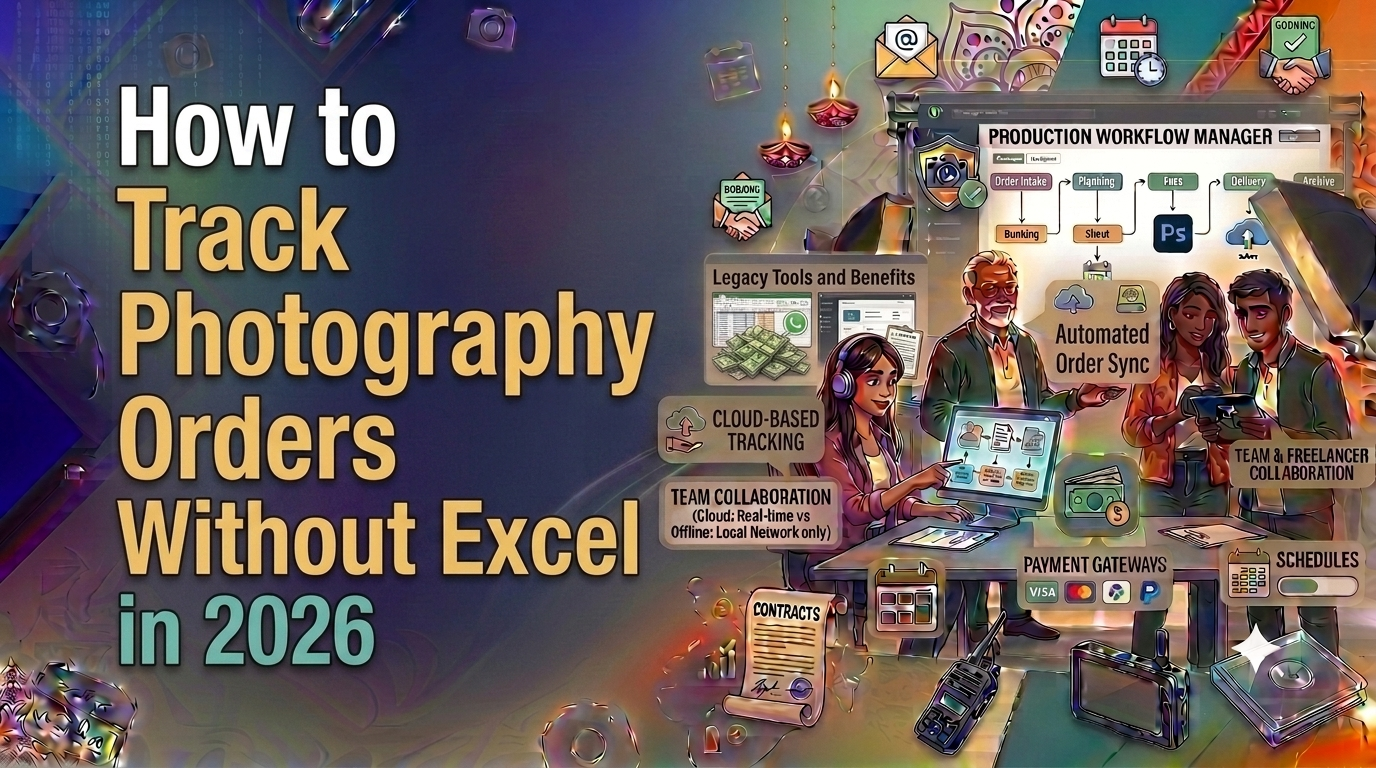
How to Track Photography Orders Without Excel in 2026
Running a successful studio in India requires managing shoot dates, client communication, advance payments, freelance crew allocations, and album deliveries simultaneously. When you are trying to figure out how to track photography orders without excel, you quickly realize that traditional spreadsheets are simply not built for the fast-paced, multi-day wedding and event schedules common in cities like Surat, Ahmedabad, Pune, and Jaipur. While spreadsheets may feel like a cost-effective choice when starting out, they rapidly turn into operational bottlenecks as your booking volume increases.
According to business research by Forbes, over 88% of complex corporate spreadsheets contain human calculation errors or broken references. For a busy studio owner handling peak wedding seasons with order values running into several lakhs of rupees, a single wrong cell entry can result in unbilled deliverables, double-booked photographers, or delayed album deliveries. Moving away from manual spreadsheets is no longer just a luxury—it is an operational necessity for scaling your photography business in India.
1. The Hidden Costs of Using Excel for Photography Orders
When starting a studio, setting up a free spreadsheet on Microsoft Excel or Google Sheets seems logical. However, as your client list expands across weddings, pre-wedding sessions, corporate events, and maternity portraits, the limitations of row-and-column tracking become painfully obvious. Managing orders manually requires constant data entry, manual cross-referencing, and repetitive updates that consume valuable creative time.
Manual Data Entry Overhead and Human Error
Every time a new booking is confirmed, you must manually type client phone numbers, shoot locations, agreed deliverables, payment milestones, and GST details into separate cells. A single typo in a contact number stops critical WhatsApp updates from reaching the client. A wrong date entry can lead to crew scheduling conflicts during peak wedding dates, potentially damaging your studio's reputation in the local market.
Lack of Real-Time Multi-User Collaboration
While cloud spreadsheets allow basic real-time sharing, they fail to provide granular permissions needed for a multi-member studio team. Editors, freelance cinematographers, album designers, and studio managers all require different levels of access. In Excel, sharing a sheet opens up the risk of someone accidentally deleting formulas, overwriting booking entries, or accessing sensitive financial margins and profit figures meant solely for the owner.
Zero Automated Reminders for Outstanding Payments
Cash flow is the lifeblood of any Indian studio business. In a spreadsheet, tracking partial payments, token advances, and final stage clearances requires manual scrutiny of every row. Without automated alert systems, follow-ups for pending payments are easily forgotten, leading to extended credit cycles and revenue leakage. According to market analysis published in Economic Times, Indian small businesses lose significant working capital each quarter due to delayed client invoicing and lack of systematic follow-ups.
Inability to Track Complex Post-Production Workflows
Tracking the status of raw file selection, color grading, teaser editing, full video renders, and physical album prints across dozens of projects is impossible inside static cells. A row marked simply "In Progress" does not tell you whether the client has selected their favorite 150 photos or if the print vendor in Delhi has shipped the final acrylic album album box.
2. Why Indian Photography Studios Need Specialized Workflow Solutions
The Indian photography market operates under distinct dynamics compared to Western countries. A typical Indian wedding involves multiple ceremonies spanning several days—Sangeet, Haldi, Mehendi, Wedding, and Reception—often hosted across multiple venues with distinct crews assigned to each event segment. Managing this level of complexity requires tools tailored to the local ecosystem.
Handling Multi-Day Event Schedules and Package Customizations
Indian clients frequently request customized packages that mix traditional photography, candid coverage, 4K video, drone coverage, same-day edit teasers, and premium printed photo books. Standard spreadsheets quickly become cluttered when trying to map distinct crews, equipment requirements, and delivery deadlines to individual sub-events within a single overall package order.
Integrated WhatsApp Communication Preferences
In India, business communication happens overwhelmingly on WhatsApp rather than email. According to market data from Nielsen, instant messaging apps boast open rates exceeding 95% in urban Indian markets. Studio management platforms that integrate direct messaging triggers offer an enormous advantage over manual email or spreadsheet-driven tracking, keeping clients informed automatically as their project moves through editing stages.
Compliance with GST and Local Billing Norms
Issuing tax invoices with appropriate GST classification (CGST and SGST for intra-state shoots, or IGST for destination weddings outside your home state) is mandatory for professional businesses. Relying on custom Excel formulas to calculate tax splits often results in rounding errors or incorrect SAC code references. Studio management software automatically calculates taxes accurately, aligning with official guidelines set by GST.gov.in.
3. Step-by-Step Guide to Transitioning Away from Spreadsheets
Moving your historical studio data out of spreadsheets into a dedicated management system might feel daunting, but following a structured approach ensures zero operational downtime or missing client information.
Step 1: Audit and Clean Up Your Existing Excel Data
Before importing your data into a new platform, clean up your spreadsheets. Consolidate client contact numbers, remove duplicate entries, verify pending balance figures, and ensure all active projects have clear current status designations (e.g., Shoot Complete, Editing, Selection Pending, Ready for Print).
Step 2: Define Standard Operating Procedures (SOPs) for Your Workflow
Map out every milestone an order passes through from inquiry to final delivery. Standardize your order lifecycle stages into logical steps:
- Inquiry & Proposal Stage
- Quotation Approval & Token Advance Received
- Pre-Shoot Planning & Team Allocation
- Shoot Execution & Raw Data Backup
- Client Selection Gallery Upload
- Post-Production (Retouching, Teaser, Full Video, Album Layout)
- Final Payment Collection & Digital/Physical Delivery
Step 3: Import Data into a Centralized Platform
Export your cleaned Excel rows as CSV files and upload them into your chosen software. Ensure that past order histories, existing client master records, and pending invoice ledgers map correctly to the new system fields.
Step 4: Train Your In-House Staff and Freelance Editors
Conduct a brief walkthrough for your team members. Assign specific role-based permissions: give editing crew access to post-production task boards, grant accounts staff access to invoicing, and reserve full master controls for the studio owner.
4. Key Features to Look For in an Order Management Tool
When selecting a platform to replace spreadsheets, prioritize features that address the actual daily friction points experienced by Indian photography studios.
Centralized Order Dashboard
Look for a visual dashboard that displays the status of all active shoots at a glance. Visual cards or status columns allow studio managers to identify bottlenecks immediately—such as an overdue album design or an uncollected advance—without scrolling through hundreds of spreadsheet rows.
Integrated Quotation and Proposal Generators
Generating professional, branded quotations quickly can make the difference between winning or losing a prospective client. A good system converts accepted estimates into confirmed orders automatically with one click. To explore how streamlined proposals improve your conversion rates, check our detailed guide on quotation management for photography studio setups.
Automated Client Portals and Selection Systems
Instead of emailing file links or relying on physical hard drives, advanced studio software offers client portals where couples can select their favorite images for album printing. The status automatically updates in your master order view once the client submits their choices.
Comprehensive Payment Gateways and Expense Tracking
Integrating payment gateways like Razorpay or PayU directly into invoice links allows clients to clear outstanding dues via UPI, credit cards, or net banking. Instant payment receipts are auto-generated, updating the order balance without manual intervention. For insights into mastering your cash flow, learn more about payment tracking for photography studio environments.
5. Comparing Excel vs. Specialized Studio Management Software
To evaluate whether upgrading from spreadsheets is right for your business, consider this comparative breakdown of operational capabilities, efficiency metrics, and risk factors.
| Feature / Capability | Excel / Google Sheets | Dedicated Studio Software |
|---|---|---|
| Order Status Visibility | Manual cell edits, prone to stale data | Real-time visual dashboards with automated stage transitions |
| Client Updates | Manual typing of WhatsApp messages / emails | Automated WhatsApp and SMS notifications triggered by status changes |
| GST Invoicing | Manual formulas, higher risk of calculation errors | Automated CGST/SGST/IGST calculation with tax compliant invoices |
| Team Task Allocation | Separate sheets or phone calls required | Integrated task boards linked directly to specific shoot orders |
| Data Security & Access Control | All-or-nothing access; risk of accidental row deletion | Role-based permissions restricting sensitive financial metrics |
| Payment Tracking | Manual bank reconciliation against spreadsheet rows | Automated payment link generation with real-time balance updates |
As highlighted in research by Gartner, organizations that replace manual operational spreadsheets with specialized workflow platforms experience a 30% reduction in administrative overhead and a significant drop in customer service complaints within the first six months of adoption.
Evaluating the Financial Impact on Studio Growth
While spreadsheets are functionally free, the time spent maintaining them represents a substantial opportunity cost. An Indian studio owner spending 8 to 10 hours per week manually updating sheets, chasing late payments, and re-checking editor assignments loses valuable time that could be invested in high-value shooting assignments, marketing, and client networking.
| Administrative Task | Hours Spent Using Excel | Hours Spent Using Studio Software | Time Saved Monthly |
|---|---|---|---|
| Creating & Sending Quotations | 12 hours | 2 hours | 10 hours |
| Chasing Outstanding Invoices | 10 hours | 1 hour | 9 hours |
| Assigning Teams & Tracking Gear | 8 hours | 1.5 hours | 6.5 hours |
| Post-Production Status Follow-ups | 15 hours | 3 hours | 12 hours |
| Total Monthly Administrative Burden | 45 hours | 7.5 hours | 37.5 hours saved |
6. Best Practices for Managing Post-Production and Team Allocation
One of the biggest operational friction points for photography businesses is post-production management. Between raw culling, retouching, video edits, color grading, and physical album printing, orders frequently stall in editing pipelines.
Structuring a Visual Post-Production Pipeline
Organize post-production tasks into sequential cards linked directly to the parent shoot order. This structure ensures editors know exactly which projects take priority based on upcoming delivery deadlines rather than who asked loudest over a phone call. Discover strategies to optimize editing workflows in our guide on post production for photography studio management.
Managing In-House and Freelance Talent Efficiently
During peak Indian wedding seasons (such as November–February and April–May), studio owners rely heavily on freelance second shooters, drone operators, and specialized video editors. Assigning crew members through a centralized system prevents accidental double-bookings across concurrent wedding events. Learn how to streamline team coordination with our resource on team management for photography studio owners.
Improving Conversion Rates from Inquiries to Paid Orders
Tracking orders starts long before the deposit is paid. Managing prospective leads systematically ensures timely follow-ups on initial inquiries, converting cold leads into booked shoots. Read our in-depth analysis on boosting your conversion rates with order conversion for photography studio growth.
7. Simplifying Financial Tracking, GST, and Payment Collections
Financial mismanagement is a primary cause of studio closures. Tracking booking advances, stage payments, and expense receipts across multiple spreadsheets often leads to inaccurate cash flow projections.
Automating Invoicing with CGST, SGST, and IGST Compliance
Indian tax regulations mandate accurate tax reporting for all commercial photographic services. Operating under a GST regime requires distinct line items for local intra-state shoots (split into CGST and SGST) versus out-of-state destination shoots (IGST). Specialized studio software handles these calculations automatically based on the client's place of supply, generating error-free tax invoices instantly.
Leveraging Automated WhatsApp Billing Reminders
Clients appreciate timely, polite payment reminders over WhatsApp containing direct digital payment links. Automating these alerts reduces awkward manual follow-ups while accelerating cash collection cycles dramatically. Explore how messaging automation enhances studio operations in our article on whatsapp integration for photography studio workflows.
Analyzing Studio Profitability with Business Reports
Spreadsheets rarely provide clear insights into which shoot categories deliver the highest profit margins. Modern studio software generates visual analytics reports showing revenue by package type, average order value, and team productivity over time. Learn how to leverage data to grow your studio using reporting tools for photography studio analytics.
8. ClickDesk: The Ultimate Studio Management Platform Built for India
If you are ready to stop wrestling with complex formulas and discover how to track photography orders without Excel effortlessly, ClickDesk is designed specifically for your business. Built from the ground up to solve the unique operational challenges faced by Indian photography studios, ClickDesk replaces fragmented spreadsheets with an all-in-one digital operating system.
Whether you operate a boutique studio in Ahmedabad, a high-volume wedding studio in Jaipur, or an event photography team in Pune, ClickDesk unifies lead tracking, client quotations, team scheduling, post-production monitoring, and financial invoicing into a single intuitive platform. Learn more about our vision and background on our about ClickDesk page.
Key Features Engineered Specifically for Indian Photography Studios:
- End-to-End Order Lifecycle Tracking: Monitor every project stage seamlessly from initial inquiry and deposit payment to post-production and final album dispatch.
- Automated Native WhatsApp Notifications: Send instant order updates, client photo selection links, and payment reminders directly to your clients' WhatsApp accounts.
- GST-Compliant Invoicing System: Generate professional tax invoices with automated CGST, SGST, and IGST calculations, complete with your studio logo and bank details.
- Interactive Quotation & Proposal Builder: Impress prospective clients with modern digital estimates that clients can review, select options on, and approve online.
- Multi-Day Event & Crew Scheduler: Assign photographers, cinematographers, drone operators, and gear sets to specific wedding functions without scheduling conflicts.
- Post-Production Kanban Task Boards: Track retouchers, editors, and print vendors with clear visual pipelines linked directly to customer orders.
To explore how ClickDesk compares to generic tools and learn why leading Indian photographers trust our ecosystem, visit our detailed review of the best feature for photography studio management software guide. Ready to select the right plan for your team size? Check out our transparent pricing plans on our ClickDesk pricing page, or browse our latest industry insights on the main ClickDesk studio management blog.
Stop wasting precious creative time maintaining complex, error-prone spreadsheets that hold your business back. Upgrade to ClickDesk today and experience seamless, automated photography order management tailored for Indian studios. Start your free ClickDesk trial today →
9. Frequently Asked Questions
Why is Excel inefficient for tracking Indian wedding photography orders?
Indian weddings involve multi-day schedules, variable deliverables (albums, reels, raw footage), crew allocations, and milestone payments. Excel lacks real-time mobile sync, automated WhatsApp updates, integrated GST calculations, and role-based post-production tracking, leading to operational bottlenecks.
How does dedicated software manage GST billing better than spreadsheets?
Dedicated platforms like ClickDesk automatically apply correct CGST, SGST, or IGST rates based on the place of supply, format SAC codes correctly, and generate compliant invoices instantly, eliminating custom spreadsheet formula errors.
Can I import my existing client records from Excel into ClickDesk?
Yes, studio owners can export their client databases and past order logs from CSV or Excel files and directly import them into ClickDesk, ensuring a smooth transition without data loss.
How does automated order tracking improve client communication via WhatsApp?
When an order stage changes (such as "Editing Complete" or "Selection Ready"), integrated systems automatically send formatted WhatsApp messages with relevant updates or gallery links directly to the client's phone.
Is studio management software expensive for small local studios in tier-2 cities?
No, modern software platforms like ClickDesk offer budget-friendly pricing plans tailored specifically for independent creators and growing studios across tier-1, tier-2, and tier-3 Indian cities like Surat, Pune, and Jaipur.