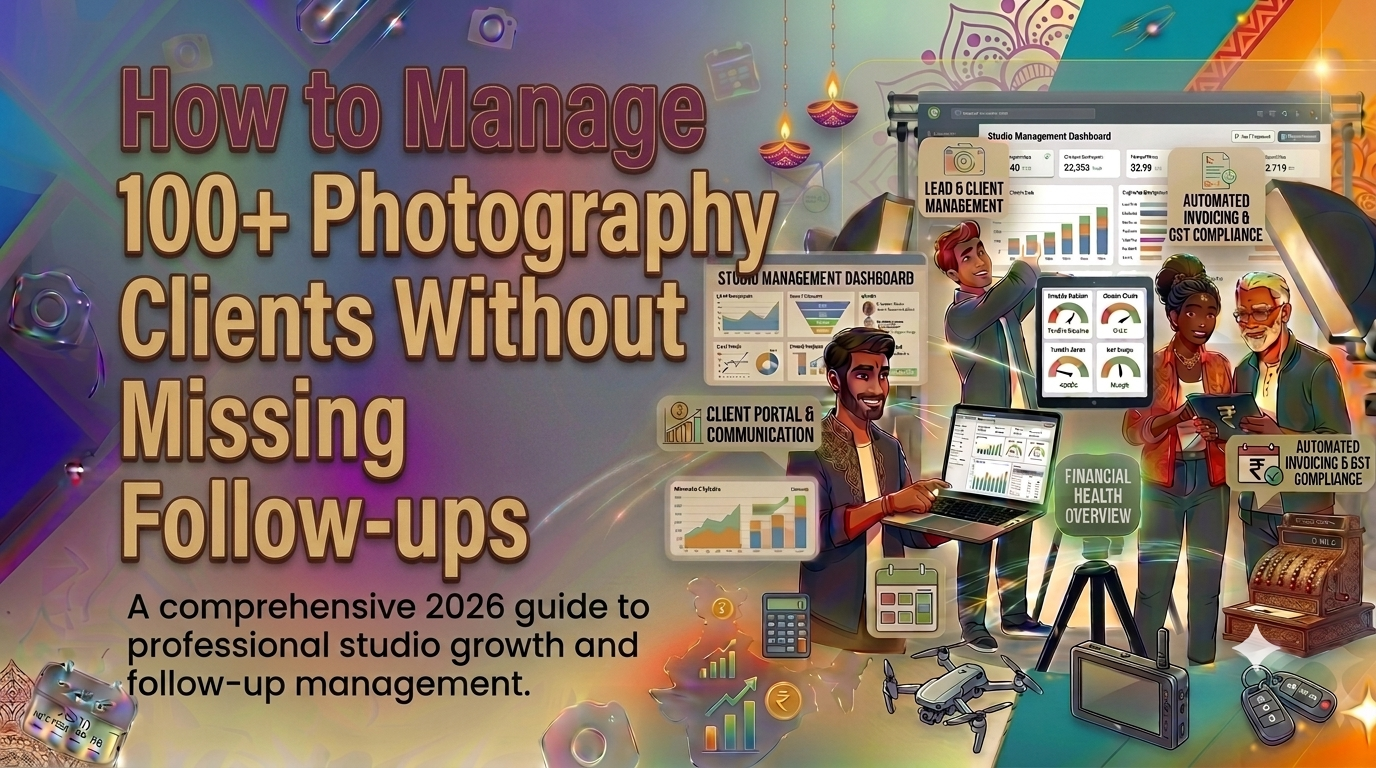
How to Manage 100+ Photography Clients Without Missing Follow-ups (2026 Guide)
1. The Operational Bottlenecks of Scale in Indian Photography Studios
Running a successful creative enterprise requires balancing artistic vision with methodical execution. In the vibrant Indian creative landscape, crossing the milestone of handling triple-digit accounts brings unique challenges. Learning how to manage 100+ photography clients without missing follow-ups is what distinguishes elite, highly profitable operations from chaotic, stressed ones. When your calendar fills up with destination weddings across cities like Jaipur and Udaipur, alongside multiple corporate headshots and commercial campaigns, relying on traditional diaries or unorganized messaging threads becomes unsustainable.
Operational complexity grows exponentially rather than linearly. According to insights on corporate growth dynamics published by the Harvard Business Review, businesses that fail to transition from ad-hoc management to structured processes encounter major service delivery drops. For a photography enterprise, this translates into forgotten callbacks, delayed photo selections, missed editing schedules, and friction in collecting final payments. In an industry where word-of-mouth recommendations are essential, a single operational slip-up can impact future bookings significantly.
The core problem stems from fragmented information. A typical workflow involves dealing with diverse components: chat logs, shared folders, physical contracts, and varying payment dates. Without a unified system, your team wastes hours searching for client records instead of focusing on high-value creative work. Furthermore, tracking complex project stages requires clear visibility into every account's current status.
| Operational Metric | Manual Tracking Methods | Automated Studio Systems |
|---|---|---|
| Lead Management | Paper notes, loose spreadsheets, scattered chats | Centralized CRM pipeline with instant history |
| Follow-up Timelines | Dependent on manual memory, leading to delays | Automated WhatsApp and email reminders |
| Invoicing & Tax Compliance | Handwritten bills, missing statutory breakdowns | Instant itemized billing with GST calculation |
| Selection Turnaround | Chasing clients over calls; prolonged timelines | Digital portals with automated cutoff reminders |
2. Establishing a Robust Communication Infrastructure via WhatsApp and Email
In India, business communication revolves largely around instant messaging apps. With high open rates, mobile chat platforms serve as a primary touchpoint for client interactions. However, using basic personal accounts to manage hundreds of clients often results in lost messages and unread threads. To maintain high professionalism at scale, studios must adopt programmatic, template-driven messaging solutions.
Integrating professional communication tools allows you to scale personal client interactions seamlessly. Research by McKinsey & Company highlights that automating repetitive customer touchpoints can boost client satisfaction ratings by up to 20%. By setting up predefined message templates for key stages—such as warm greetings, calendar bookings, selection follow-ups, and balance reminders—you keep clients informed without manual effort. Discover how automated workflows can optimize your studio by exploring the best feature for photography studio management software.
A balanced communication plan combines the immediacy of text messaging with the formal structure of email. While text updates are great for quick updates like photo reminders or payment links, comprehensive documents—like creative briefs, contract terms, and itemized bills—belong on email. This professional approach protects your business interests and provides clear, legal records if disagreements arise regarding project scopes.
Moreover, structured communication helps set healthy boundaries with clients. Clearly defined milestones outline exactly when clients will receive their previews, selection links, and finalized files. Providing this clarity upfront minimizes constant check-ins, allowing your team to focus on editing and creative production.
3. Designing an End-to-End Client Pipeline: Lead to Final Album Delivery
Managing over a hundred accounts concurrently requires a clearly defined operational pipeline. Every project must move smoothly through specific phases, ensuring that no client is forgotten or left waiting. This structured lifecycle is typically broken down into five core stages:
3.1 Intake, Evaluation, and Automated Proposal Tracking
The client journey begins the moment an inquiry arrives. Capturing key data points immediately—such as the event date, venue location, budget, and requested coverage style—is essential. Prompt responses are critical; an inquiry left unanswered for 24 hours often turns into a lost opportunity. Using smart web forms to collect data and automatically generate detailed quotes ensures you present professional pricing fast. To learn more about setting up polished, standardized proposals, review our guide on quotation management for photography studio setups.
3.2 Booking Finalization and Order Conversion Workflows
Once a client selects a package, converting that lead into a confirmed booking requires clear execution. This step involves securing a signed agreement and an initial retainer payment. A formal contract protects both parties by detailing clear policies on cancellation terms, travel logistics, and copyright ownership. Streamlining this transition helps protect your revenue and establishes clear expectations from day one. Explore optimal techniques for securing bookings through structured order conversion for photography studio processes.
3.3 Pre-Event Preparation and Creative Strategy Sessions
In the weeks leading up to a major shoot, operational focus shifts to planning and logistics. This involves conducting creative alignment calls, visiting venues, and finalizing schedules. Having a centralized system ensures that details like event timelines, family structures, and specific shot lists are easily accessible to all assigned photographers and videographers, preventing confusion on site.
3.4 Post-Production Management and Selection Pipelines
The phase after the shoot is often where bottlenecks occur. Managing thousands of high-resolution images requires efficient sorting, culling, and backup routines. Providing clients with organized, user-friendly digital proofing galleries speeds up the selection process significantly. Clear deadlines and automated reminders encourage clients to make their selections promptly, keeping the project on schedule. To learn more about optimizing post-shoot production, check out our insights on post production for photography studio workflows.
3.5 Final Review, Manufacturing, and Delivery Archives
The final step involves retouching selections, layout design, and printing physical albums. Keeping clients updated during printing and shipping builds trust and satisfaction. Once delivered, safely archiving master files allows you to fulfill future reprint requests, creating additional long-term revenue opportunities.
4. Financial Management: GST Compliance, Invoicing, and Payment Milestones
Managing financial health is crucial when handling a high volume of clients. In India's regulatory environment, running a high-turnover studio requires strict compliance with tax guidelines. According to national economic reports on Statista, service sectors driven by digital transformation show improved resilience when adopting formal corporate practices. For studio owners, this means moving away from informal cash dealings and setting up robust, tax-compliant billing systems.
Accurate tax handling requires split calculations for Central GST (CGST) and State GST (SGST) on local jobs, or Integrated GST (IGST) for out-of-state projects like destination weddings. Providing itemized invoices that detail food, lodging, and travel expenses separately ensures compliance with rules found on GST.gov.in. It also reassures corporate clients that they can claim input tax credits easily.
Additionally, dividing package costs into clear, milestone-based payments helps maintain steady cash flow. A common structure used by leading Indian photography studios includes:
- Booking Retainer: 30% due immediately to secure the calendar date.
- Pre-Event Milestone: 50% due on or before the main event date.
- Delivery Balance: 20% due upon approval of photo selections, prior to final album printing.
Integrating local payment gateways like Razorpay or PayU lets clients pay securely via UPI, credit cards, or net banking. This reduces the need to chase payments manually and ensures deposits match directly with open invoices. Discover how automated financial tracking can streamline your business with our specialized tools for payment tracking for photography studio management.
5. Team Delegation and Task Assignment Across Post-Production Workflows
A studio owner cannot manage every aspect of a high-volume business alone. As your client base grows past one hundred accounts, success relies on efficient team collaboration. Your core team typically includes lead photographers, second shooters, editors, album designers, and client coordinators. Keeping everyone aligned requires clear task assignment and real-time tracking.
Without clear delegation, crucial tasks like data backups or final retouches can easily be overlooked. Assigning clear owners and due dates for each step ensures accountability across the board. To learn more about organizing your crew and tracking schedules, explore our guide on team management for photography studio success.
| Studio Role | Core Responsibility | Key Performance Metric (KPI) |
|---|---|---|
| Lead Photographer | On-site creative execution & data offloading | Zero data loss; on-time arrival |
| Studio Coordinator | Client onboarding & automated follow-ups | Follow-up response time under 4 hours |
| Culling Editor | First-pass filtering and selection hosting | Proofing links delivered within 7 days |
| Retouching Artist | Color grading and advanced portrait edits | Per-image edit time under 12 minutes |
| Album Designer | Layout compilation & print coordination | Client layout approval within 2 review rounds |
Regular review meetings help identify operational bottlenecks before they cause project delays. Tracking team performance metrics allows you to adjust workloads during peak seasons, ensuring consistent quality and on-time deliveries for every client.
6. Transform Your Studio Operations with ClickDesk
Built specifically for the dynamic needs of the Indian creative industry, ClickDesk is a comprehensive photography studio management platform. It helps studio owners move away from chaotic manual tracking and implement organized, automated workflows that support business growth.
Whether you run a boutique team in Pune or a large production house in Ahmedabad, ClickDesk provides the tools needed to manage a high volume of accounts efficiently, keep projects on schedule, and protect your profit margins.
- Indian Tax Compliance: Generate clear invoices with accurate CGST, SGST, and IGST breakdowns effortlessly.
- Direct WhatsApp Integration: Send automated updates, selection alerts, and payment links straight to your clients' favorite messaging app. Learn more about configuring this via our whatsapp integration for photography studio feature page.
- Milestone Payment Tracking: Connect with popular gateways like Razorpay to collect retainers and track balances automatically.
- End-to-End Visual Pipelines: Track every project's progress from initial lead to final album delivery instantly.
- Smart Team Delegation: Assign specific tasks to editors and shooters, set deadlines, and monitor performance in real time.
- Comprehensive Performance Analytics: Gain clear insights into studio revenue, pending balances, and project timelines. Explore these capabilities further on our reporting tools for photography studio analytics page.
Ready to streamline your studio operations, save valuable hours, and elevate your client experience? Review our affordable subscription plans on the ClickDesk pricing page and select the perfect fit for your business goals.
Take full control of your business growth and eliminate operational stress permanently. Discover how our specialized features can help you scale your studio smoothly and professionally. Start your free ClickDesk trial today →
7. Frequently Asked Questions (FAQ)
What is the best way to handle multiple client follow-ups during peak wedding season?
The most effective approach is to automate your system using a tailored studio management software like ClickDesk. By setting up automated WhatsApp and email alerts tied to specific workflow triggers—such as advanced booking confirmations, layout selections, and pending balance clearances—you eliminate manual errors and ensure clients receive timely updates even during busy schedules.
How can I accurately calculate GST for a photography package split across states?
If your studio is based in one state (e.g., Gujarat) and you travel to another state (e.g., Rajasthan) for a destination shoot, you must determine the Place of Supply according to the Indian statutory rules available on GST.gov.in. Usually, inter-state services incur Integrated GST (IGST), while local assignments incur Central GST (CGST) and State GST (SGST). Utilizing invoicing tools built for India makes this simple.
What steps can prevent delays in the photo selection process by clients?
Delays happen when clients are overwhelmed by large file counts or hard drives. You can resolve this by hosting images on organized digital proofing platforms, capping selection window deadlines in your terms, and utilizing automated messaging tools to remind them of the timeline so your post-production pipeline keeps moving forward.
Should small photography studios invest in full-scale CRM software?
Yes, investing early protects your cash flow and builds scalability. Even if you handle fewer than fifty clients currently, deploying a photography studio management software like ClickDesk establishes standard operating procedures. This keeps documentation structured, payment tracking bulletproof, and professional templates ready before you cross the hundred-client mark.
How do payment gateway integrations improve cash collection workflows?
Integrating domestic payment systems such as Razorpay or PayU directly into your booking invoices allows clients to execute immediate payments via UPI, Credit Cards, or NetBanking. This removes the friction of manually sharing bank details and cross-verifying deposits, reducing administrative work significantly.