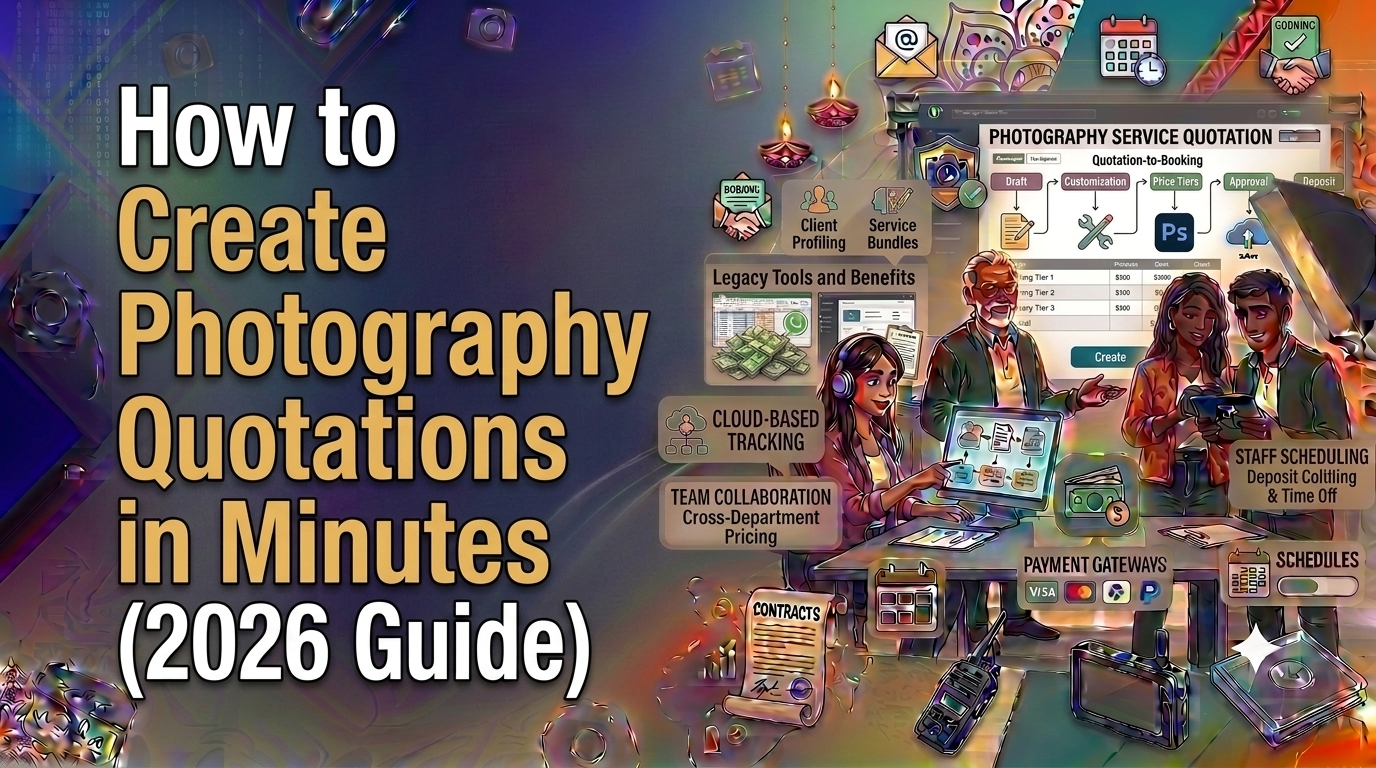
How to Create Photography Quotations in Minutes (2026 Guide)
In the fast-paced visual creative industry across India, speed is often the deciding factor between securing a high-value booking and losing a prospect to a competitor. When an inquiry comes in for a three-day destination wedding in Jaipur or a corporate campaign in Surat, clients expect fast, professional, and clear pricing breakdowns. If you take days to respond because you are building estimates manually in Excel or Word, your prospective clients will simply move on. Knowing how to create photography quotations quickly and accurately is no longer just an administrative skill—it is a core revenue-driving engine for modern studio owners.
This comprehensive 2026 guide covers everything you need to know about streamlining your studio’s pricing workflow. You will learn the structural anatomy of high-converting estimates, strategies to automate tax and deliverable calculations, methods to handle client negotiations seamlessly, and how dedicated management software can transform your administrative workload from hours into seconds.
1. The High Cost of Slow Photography Quotations
The photography market in India has seen unprecedented growth over the last decade. According to market analysis published by Statista, the Indian media and event services ecosystem continues to expand rapidly, fueled by luxury weddings, commercial e-commerce shoots, and corporate branding. However, this growth brings intense market competition. Studio operational managers in hubs like Ahmedabad, Pune, and Bengaluru face clients who compare multiple vendors simultaneously.
When a prospective client contacts your studio, their buying intent is at its peak. If your response is delayed by 24 to 48 hours because you need to manually calculate crew costs, camera gear rentals, post-production estimates, and GST percentages, that enthusiasm evaporates. A delay signals a lack of organization, causing potential clients to assume your on-stage or post-production workflow will suffer from similar lag.
Furthermore, manual quoting processes open the door to human errors. Calculating complex deliverables across multi-day shoots on spreadsheet templates often leads to mispriced gear charges, incorrect tax application, or forgotten line items. These errors either cost you profit margins or result in uncomfortable billing renegotiations with your client down the road.
2. Key Elements of a High-Converting Photography Quotation
A photography estimate is not merely an invoice-in-waiting; it is a vital sales asset. It must communicate brand value, establish professional trust, define explicit boundaries to avoid scope creep, and guide the prospective client seamlessly toward paying a deposit. Missing critical sections can cause misunderstandings regarding raw file handovers, album print counts, or event overtime charges.
Essential Components of Every Estimate
To ensure clarity and legal enforceability, every proposal should strictly include:
- Header & Branding: Official studio logo, registered company name, address, contact phone, email, and GSTIN (if registered).
- Client Details: Full name of the client, event/project title, venue location, and contact details.
- Unique Reference & Date: Quotation identification number, date of issue, and an explicit validity expiry date (e.g., valid for 14 days).
- Itemized Scope of Work: Detailed line items breaking down photography styles (Candid, Traditional, Cinematic Video), crew count, hours of coverage, and equipment setups.
- Deliverable Checklist: Quantifiable outputs such as processed high-resolution JPEGs, raw files status, teaser video lengths, photobook album parameters, and delivery timelines.
- Financial Breakdown: Subtotal, explicit GST calculation breakdown (CGST + SGST for intra-state or IGST for inter-state), discount applications, and final total in ₹ (INR).
- Payment Schedule: Clear milestone breakdown (e.g., 30% advance booking fee, 60% on event date, 10% upon final photo/album delivery).
- Terms & Conditions: Brief statements detailing cancellation policies, overtime fees per hour, client usage rights, copyright retention, and travel/accommodation responsibility clauses.
Sample Photography Cost Calculation Structure
Below is an example of a balanced, professional price breakdown table for a typical two-day wedding shoot in India:
| Service / Deliverables Description | Qty / Crew | Duration | Standard Rate (₹) | Total Amount (₹) |
|---|---|---|---|---|
| Lead Candid Photographer | 1 | 2 Days | ₹25,000 / day | ₹50,000 |
| Cinematic Video Director & Crew | 2 | 2 Days | ₹40,000 / day | ₹80,000 |
| Traditional Photo & Video Operators | 2 | 2 Days | ₹20,000 / day | ₹40,000 |
| Premium Flush-Mount Album (40 Sheets) | 2 Albums | Deliverable | ₹15,000 / unit | ₹30,000 |
| Teaser Reel (60 sec) + Full Highlights Film | 1 Package | Post-Production | ₹25,000 | ₹25,000 |
| Subtotal | - | - | - | ₹2,25,000 |
3. Step-by-Step Guide: How to Create Photography Quotations in Minutes
Creating estimates under pressure without sacrificing detail or professionalism requires a standardized, repeatable system. By following these five organized steps, your team can drastically shrink proposal production times while improving accuracy.
Step 1: Conduct a Brief In-depth Discovery
Never send a quote blindly without establishing basic event parameters. Gather crucial specifics immediately through an intake form or initial phone conversation. Key parameters include date, exact location, shoot duration, expected guest count, and specific deliverable requirements. Misinterpreting a client's scope leads to underquoting and lost revenue.
Step 2: Utilize Standardized Service Packages
Avoid constructing every line item from scratch. Develop standard package templates within your studio operations for recurring client requests—such as standard pre-wedding shoots, corporate headshots, or 3-day wedding packages. Having structured base templates allows you to tailor a quote quickly by simply adjusting specific add-ons or crew quantities.
Step 3: Define Clear Line-Item Pricing
Transparency builds confidence. List individual line items clearly so clients understand exactly where their investment goes. When clients request budget adjustments, itemized quotes make it easier to modify specific elements—such as reducing album print counts or adjusting crew hours—rather than cutting your overall profit margins blindly.
Step 4: Calculate Taxes and Operational Expenses Correctly
Ensure that all applicable local government duties, equipment rentals, travel allowances, and assistant fees are accounted for. Explicitly specify whether travel and lodging costs for outstation assignments (e.g., destination shoots in Udaipur or Goa) are included in the subtotal or billed actuals later.
Step 5: Review, Format, and Deliver Promptly
Double-check all figures for accuracy. Export the proposal into an easily readable format, generate a clean digital link, and send it directly via modern communication channels like WhatsApp or email with a courteous personalized message.
4. Navigating Indian Tax Rules: GST, CGST, and SGST Integration
Operating a photography business in India requires strict adherence to commercial compliance standards set by tax authorities. Failing to manage tax documentation professionally can lead to substantial penalties or confusion during auditing season. Detailed statutory guidelines on service classifications can be verified directly on the official GST Council Portal.
For photographers registered under the Goods and Services Tax framework, professional photographic services and video recording fall under standard SAC (Services Accounting Code) classifications, typically taxed at 18%. Presenting tax breakdowns correctly on your estimates demonstrates business maturity and aids corporate clients in claiming Input Tax Credit (ITC).
Understanding Tax Types in Photography Proposals
- Intra-State Transactions (Same State): When your studio and client are located in the same state (e.g., a Surat-based studio shooting in Vadodara), the tax is split equally into CGST (9%) and SGST (9%).
- Inter-State Transactions (Different States): When shooting across state borders (e.g., a Pune studio traveling to Jaipur), apply IGST (18%) directly to the subtotal.
Including GSTIN fields, valid tax percentages, and structured invoice conversion rules in your original quote streamlines your entire workflow, ensuring smooth transitions to payment tracking when assignments are confirmed.
5. Manual Estimation vs. Automated Studio Systems
Many photography business owners rely on offline tools like Microsoft Word, Canva, or basic spreadsheet templates. While accessible, these manual methods introduce significant operational bottlenecks as your inquiry volume scales.
Industry surveys by business consultancies like Gartner emphasize that digital automation in client management workflows drastically reduces administrative costs while boosting customer satisfaction. The operational comparison below highlights why moving to dedicated automation yields dramatic efficiency gains:
| Workflow Feature | Manual Method (Excel / Word / Canva) | Automated System (ClickDesk) |
|---|---|---|
| Average Creation Time | 30 to 60 Minutes per quote | Under 2 Minutes |
| Calculation Accuracy | High risk of manual math & tax errors | 100% automated precision |
| GST & SAC Support | Requires manual percentages entry | Built-in automatic CGST/SGST/IGST breakdown |
| Client Approval Tracking | Requires manual follow-up messages | Real-time notifications on quote views/accepts |
| Lead Management Sync | Isolated files stored on hard drives | Directly tied to lead status and job records |
| Invoice Conversion | Re-typing data manually into invoice files | One-click auto-conversion to GST tax invoice |
6. Best Practices for Delivering Quotations via WhatsApp and Email
In India's mobile-first business ecosystem, sending a proposal as a static email attachment often results in unread messages. According to digital engagement research published by Nielsen, instant messaging channels achieve open rates exceeding 80%, outperforming traditional communication methods by a wide margin.
To maximize conversion rates when delivering proposals, implement these practical communication habits:
- Deliver via Direct Mobile Links: Instead of attaching heavy PDF files that waste bandwidth, share quick web-links that allow clients to view estimates instantly on mobile screens.
- Follow Up Promptly: Send a brief, polite check-in via WhatsApp within 24 to 48 hours. Express enthusiasm for their upcoming event and invite any questions regarding package customization.
- Offer Digital Acceptance & Payment Options: Make it simple for clients to accept quotes and pay advance deposits right away using modern payment gateways like Razorpay or PayU. Eliminating friction speeds up overall booking confirmations.
7. Harnessing ClickDesk for Instant Quotation Management
ClickDesk is an all-in-one studio management platform designed specifically for Indian photography studios. Whether running a boutique wedding photo studio in Surat or managing large production teams across Mumbai, ClickDesk simplifies administrative complexity so you can focus on your creative work.
From handling incoming inquiries to generating polished proposals and tracking editing workflows, ClickDesk equips your business with intelligent, localized tools. You can learn more about how our platform addresses operational challenges by reviewing our comprehensive guide on the best features for photography studio management software.
Key Features Built for Indian Studios
- Instant Professional Quotation Creation: Generate branded estimates in under two minutes using pre-saved service packages and price templates.
- Automated GST Compliance: Effortlessly apply CGST, SGST, or IGST rates with one-click SAC code configurations.
- Seamless WhatsApp Integration: Send quotes, booking updates, and payment links directly to your clients on WhatsApp. Explore our specialized WhatsApp integration for photography studios.
- One-Click Quotation-to-Invoice Conversion: Convert approved estimates into formal tax invoices instantly, keeping your records accurate without extra data entry. Learn more about our quotation management tools.
- Integrated Advance Payment Tracking: Track incoming payments and record transactions seamlessly using Indian digital payment gateways like Razorpay and PayU. Discover our payment tracking solutions.
- End-to-End Workflow Management: Assign shoot schedules, manage editing workflows, and track crew assignments effortlessly. Explore our post-production management and team management modules.
Explore our transparent subscription options on our ClickDesk pricing page, or discover our studio management mission on our about us page. For broader context on modern photography business automation, visit our main studio management blog hub.
Ready to automate your studio operations, eliminate manual billing errors, and convert inquiries into paid clients faster than ever? Start your free ClickDesk trial today →
8. Frequently Asked Questions (FAQ)
How long should it take to send a photography quotation?
Ideally, you should send a quotation within 15 to 30 minutes of receiving an inquiry. Studies show that responding rapidly dramatically increases conversion rates. Using studio management automation like ClickDesk allows studios to generate and dispatch accurate quotes in under two minutes.
Is GST mandatory on photography service quotations in India?
If your studio's aggregate annual turnover exceeds ₹20 Lakhs (or ₹10 Lakhs in special category states), registering for GST is mandatory. Even if un-registered initially, including a transparent breakup of applicable taxes in your estimate prevents scope disputes later.
What essential details must be included in a photography estimate?
A comprehensive photography quotation must feature lead details, a detailed scope of work (hours, coverage, deliverables, crew size), itemized package costs, payment terms, advance payment schedules, validity period, and copyright/cancellation policies.
How can I prevent clients from ghosting me after receiving a quote?
Clients often ghost when quotes lack clarity or take too long to arrive. By utilizing ClickDesk to instantly send web-link quotations directly to WhatsApp, tracking client view activity, and offering clear digital approve-and-pay options, studios significantly reduce client drop-offs.
Should I share detailed line items or bundled packages in my quotation?
A hybrid approach works best. Present attractive bundled tiers (e.g., Traditional + Candid Wedding Package) while keeping optional add-ons (like pre-wedding shoots, extra photobooks, or drone coverage) itemized so clients can customize their package easily.