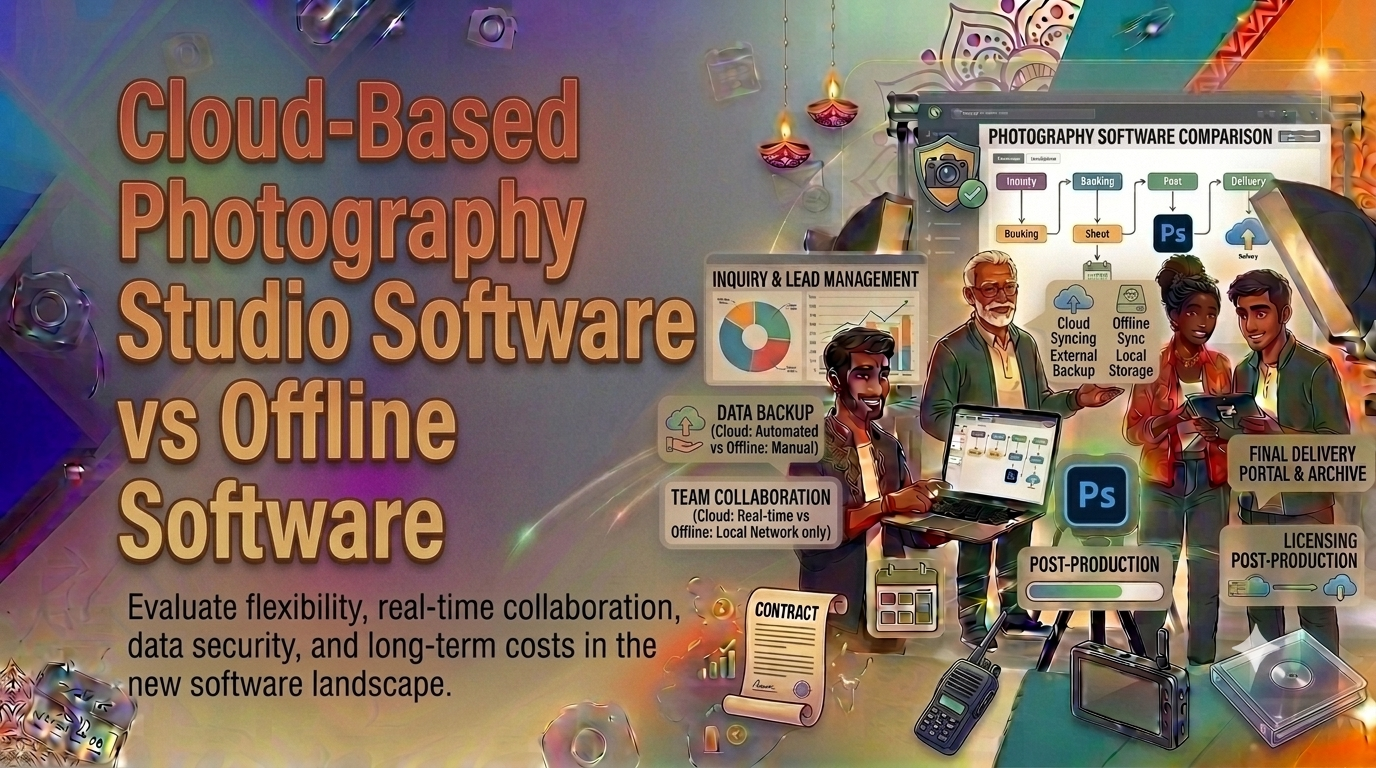
Cloud-based Photography Studio Software
vs OfflineSoftware (2026 Guide)
1. Introduction: The Tech Evolution of Indian Photography Studios
Running a successful photography studio in India has undergone a massive transformation over the past decade. Managing a photography business is no longer just about framing a scene or investing in high-end mirrorless camera bodies and prime lenses. Studio owners across hubs like Surat, Ahmedabad, Jaipur, Pune, and Bengaluru operate complex enterprise operations. On any given weekend during the peak Indian wedding season, a studio owner might coordinate multiple simultaneous shoot crews across different venues, track lakhs of rupees in client advance deposits, handle post-production color grading pipelines, and deliver thousands of high-resolution images.
When choosing the structural foundation for studio operations, owners face a vital choice: selecting **cloud-based photography studio software vs offline software**. Legacy studios previously relied heavily on local desktop applications, custom Microsoft Excel sheets, or offline billing software stored on a single studio desktop computer. However, as business models expand to accommodate multi-city destination weddings and rapid client communication channels, traditional offline desktop tools often create operational bottlenecks.
According to research published by Gartner, enterprise adoption of cloud architecture across service industries has grown rapidly due to superior operational flexibility, real-time collaboration, and lower hardware maintenance overheads. Similarly, the Indian digital ecosystem—fueled by high-speed 5G connectivity and unified digital payment systems—has shifted how wedding and commercial photography clients interact with creative businesses. In this comprehensive 2026 guide, we analyze the structural, operational, and financial differences between cloud and offline studio management software to help you make an informed decision for your photography business.
2. What is Offline Studio Management Software?
Offline photography studio software refers to applications installed directly onto a specific desktop or laptop computer hard drive. The database—containing your client booking details, quotation logs, expense entries, and payment history—is stored locally on that single device's physical storage unit.
Key Characteristics of Offline Systems
- Local Installation: Executable files run on Windows or macOS desktop environments without requiring continuous internet connectivity.
- Isolated Database: Data remains inside local hard drives, meaning access is restricted to the physical premises of your studio office.
- Manual Backups: System back-ups require studio owners to manually export database copies to external hard disks or flash drives.
- Static Licensing: Often sold under single-user, legacy software license models with separate fees for major software updates.
While offline systems historically offered peace of mind regarding internet outages, they create restrictive silos for modern photo studios. If your lead photographer or studio manager is away on location for a destination shoot in Udaipur, they cannot view client contract details, update project milestones, or verify whether a pending balance payment was received without phoning someone back at the main studio desk.
3. What is Cloud-Based Photography Studio Software?
Cloud-based studio management software runs on secure remote cloud servers. Studio owners, admin staff, client relations teams, and freelance editors log into the platform through secure web browsers or mobile applications from any device connected to the internet.
Key Characteristics of Cloud Systems
- Universal Accessibility: Access studio operational dashboards 24/7 from smartphones, tablets, laptops, or desktops.
- Real-Time Synchronisation: Changes made by an admin in Surat instantly reflect on the mobile app used by a shoot team on-site in Delhi.
- Automated Infrastructure: Data security, encrypted off-site backups, and feature upgrades are managed directly by cloud software providers.
- Integrated Communication: Deep API integration with payment processors like Razorpay or PayU, as well as modern messaging networks like WhatsApp.
As documented in modern business studies by Harvard Business Review, real-time data accessibility across distributed teams improves operational efficiency while reducing administrative response times. For an Indian wedding studio managing tight booking schedules and multiple delivery dates, instant cloud access eliminates scheduling conflicts and missing records.
4. Detailed Comparison: Cloud vs. Offline Software
To evaluate how these two software paradigms perform under real studio conditions, let us compare their architectural strengths and weaknesses across critical operational parameters.
Data AccessibilityAnytime, anywhere via laptop, smartphone, or tabletRestricted to the single computer hosting the softwareMulti-User CollaborationReal-time concurrent access with customized staff role permissionsSingle-user access; file sharing requires manual file exportsData Loss RiskNear-zero risk; automated, multi-region encrypted cloud backupsHigh risk; dependent on manual external drive backups and local hardware healthGST Billing & UpgradesAutomated tax logic updates based on Indian tax policy shiftsRequires manual software repurchasing or manual tax rule configurationClient Engagement ToolsDirect automated WhatsApp messaging, SMS, and online payment linksManual telephone calls, manual SMS tools, and cash/cheque collectionInitial Setup InvestmentZero hardware outlay; low, predictable monthly/annual subscriptionsHigh upfront license fees, database setup expenses, and dedicated PC costs| Operational Feature | Cloud-Based Studio Software | Offline Desktop Software |
|---|
The operational gap becomes clear when handling rapid client queries. When a potential client calls asking about date availability and package pricing, a studio utilizing a modern quotation management system for photography studios can generate and send an itemized quotation directly from a smartphone within two minutes. In contrast, an offline user must travel back to their desk office computer to generate a PDF invoice or log a new lead entry.
5. Mobility and Remote Team Management on Destination Shoots
The Indian wedding photography landscape is defined by destination events. A studio headquartered in Pune may execute multi-day shoots across Rajasthan, Goa, and Kerala during peak season. Managing creative crews across geographic locations requires centralized coordination tools.
Using cloud software, your studio manager can assign shoot tasks, equipment checklists, and shot lists directly through team management software for photography studios. Field photographers receive instant mobile notifications containing exact venue locations, client contact names, and event timing schedules. When shoot milestones are completed on location, photographers update task statuses in real time, giving studio managers complete visibility over event execution without constant phone calls.
Offline desktop applications simply cannot support this degree of remote coordination. Once your team leaves the studio office premises, offline software becomes inaccessible, forcing staff back to fragmented WhatsApp chats, paper notes, and unorganized telephone calls that increase the risk of lost client details.
6. Data Loss Risks: Local Hard Drives vs. Encrypted Cloud Storage
A photographer's database is the backbone of their business. It contains years of historical client contact details, financial revenue logs, booking dates, pending invoice ledgers, and copyright agreement terms. Losing this data can cause severe financial and legal disruption.
The Vulnerabilities of Offline Data Storage
Local desktop hard drives are susceptible to physical failure. Hardware component degradation, unexpected power surges—common in many Indian commercial zones—ransomware virus infections, water damage, or office break-ins can instantly destroy local databases. Research from Statista shows that SMBs relying exclusively on local, non-backed-up storage experience significantly longer operational recovery times following critical hardware failures.
Cloud Infrastructure and Data Resilience
Professional cloud studio management tools utilize enterprise-grade cloud server hosting (such as Amazon Web Services or Microsoft Azure) protected by SSL encryption and multi-region data redundancy. Even if a studio laptop is stolen or broken on a field shoot, your business records remain safe. You can simply log into your cloud portal from a replacement device and resume business operations immediately without missing a single client record.
7. Financial Management: GST Invoicing, Advance Payments, and Payment Gateways
Managing financial records in India requires precise compliance with tax guidelines set by the Goods and Services Tax Network (GSTN). Photography services generally attract standardized GST rates, requiring detailed invoicing that accurately separates State GST (SGST) and Central GST (CGST) for intra-state shoots, or Integrated GST (IGST) for inter-state destination work.
Modern studio workflows require structured tracking systems that handle multi-stage advance payments. Wedding photography contracts routinely involve a 20% initial booking deposit, a 60% advance payment prior to the event date, and a final 20% balance upon album delivery. Tracking these installment schedules across 40 different clients manually using offline tools often leads to missed payment collections and balance discrepancies.
Cloud systems simplify financial management through automated payment workflows:
- Automated Tax Invoicing: Systems generate GST-compliant tax invoices complete with HSN/SAC codes, business details, and automatic tax breakdowns.
- Direct Payment Gateway Integration: Send payment links via SMS or messaging apps linked to Indian payment gateways like Razorpay or PayU. Clients can clear pending balances using UPI, credit cards, or net banking.
- Real-Time Payment Tracking: Utilizing dedicated payment tracking software for photography studios updates account ledgers automatically the moment a client clears a payment link.
- Order Conversion Rules: Convert validated quotations into active booking orders using order conversion software for photography studios without re-keying financial values.
8. Client Experience: Automated WhatsApp Alerts vs. Manual Follow-ups
Customer experience expectations in India are closely tied to instant messaging. According to market research by Nielsen, Indian consumers prefer receiving transactional alerts, booking confirmations, and billing updates via messaging platforms rather than email.
Cloud management platforms integrate directly with official messaging channels to deliver automated updates. For example, cloud software featuring native WhatsApp integration for photography studios sends automated event reminders, payment receipt confirmations, and photo selection notifications directly to a client's smartphone.
Initial Inquiry ResponseInstant automated digital quote sent to client's WhatsAppManual creation of PDF invoice sent via email hours laterBooking ConfirmationDigital contract signing and instant automated payment receipt generationPhysical signature or manual bank transfer verification via manual phone callPre-Event CoordinationAutomated messaging alerts sent to crew and client prior to eventManual phone calls from studio staff to confirm crew timingPost-Production DeliveryAutomated tracking alerts linked to post-production software for photography studiosManual phone updates or text messages regarding album selection status| Touchpoint Phase | Cloud-Based Automated Workflow | Offline / Manual Workflow |
|---|
This automated flow projects a refined brand image, reassures clients, and eliminates manual follow-up calls, allowing studio staff to focus on creative execution.
9. Cost Analysis: One-Time Licenses vs. Subscription Efficiency
A common misconception among studio owners is that offline software is cheaper because it is marketed as a "one-time software purchase." A detailed Total Cost of Ownership (TCO) analysis reveals a different reality over a 3-to-5-year operational horizon.
The Hidden Costs of Offline Software
Initial purchases of offline software often cover only the base desktop license. As operating systems update (such as major updates to Windows or macOS), offline software frequently experiences compatibility issues, requiring paid version updates. Furthermore, studio owners must invest in secondary backup hardware, local network servers, and IT support services to maintain local databases.
The Financial Clarity of Cloud Subscriptions
Cloud platforms operate on predictable subscription models. These subscriptions cover hosting, data maintenance, security protocols, system upgrades, and customer support. Furthermore, modern business reporting capabilities, such as integrated reporting tools for photography studios, deliver clear visibility into revenue trends, overhead costs, and profit margins, enabling data-backed business decisions.
According to economic studies published in The Economic Times, Indian MSMEs adopting cloud software models reduce capital expenditure (CapEx) while converting technology costs into flexible, tax-deductible operational expenditures (OpEx).
10. Why ClickDesk is the Ultimate Cloud Solution for Indian Photography Studios
If you are looking for a cloud platform built specifically for Indian photography studios, ClickDesk provides a comprehensive management software designed for the real-world operational needs of studio owners across India.
ClickDesk bridges the gap between client communications, event coordination, field management, and financial accounting within a secure cloud dashboard. Whether you run a high-volume wedding photography firm in Jaipur or a portrait studio in Surat, ClickDesk simplifies administrative workflows so you can focus on expanding your business.
India-Specific Features Built Into ClickDesk:
- Native WhatsApp Business Integration: Send quotes, payment links, event reminders, and digital invoices directly to your clients' WhatsApp.
- GST-Compliant Smart Invoicing: Automatically generate proper tax invoices calculating CGST, SGST, and IGST for state and inter-state shoots.
- Indian Payment Gateway Sync: Accept payments via UPI, Credit/Debit cards, and Net Banking using seamless integrations with Razorpay and PayU.
- Comprehensive Lead & Quote Management: Convert leads into confirmed orders using specialized order conversion tools and branded digital quotations.
- Multi-Event Crew Scheduling: Assign shoot tasks, manage freelance crew rosters, and track event progress across cities in real time.
- Post-Production Milestone Tracker: Keep clients informed through every step of photo culling, color grading, design, and album printing.
Interested in learning how ClickDesk can transform your studio operations? Explore our full studio software features breakdown or review our flexible, transparent ClickDesk software pricing plans designed for growing creative teams.
Transform Your Photography Business Operations Today
Ready to upgrade from legacy desktop spreadsheets and offline tools? Switch to India's dedicated cloud management platform built exclusively for professional photography studios and scale your operational efficiency effortless.
11. Frequently Asked Questions (FAQ)
Is my photography studio data safe in cloud-based software?
Yes. Cloud-based studio management software like ClickDesk utilizes encrypted databases, automated daily cloud backups, and secure server architecture. This offers significantly better protection against hard drive crashes, theft, or physical damage than local desktop software.
Can I operate cloud studio software without high-speed internet in India?
Modern cloud platforms are optimized for low bandwidth and mobile networks (4G/5G) across Indian cities and shoot locations. You can check schedules, view booking info, and log updates directly from your smartphone on field locations.
How does cloud software handle GST billing for Indian photography studios?
Cloud platforms like ClickDesk automatically calculate CGST, SGST, and IGST rates, format legal invoices, and split multi-tier payment advances into clear tax reports compliant with Indian GST standards.
Why is offline studio software becoming outdated for wedding photographers?
Offline software restricts your data to one physical computer. It lacks real-time mobile updates, automated WhatsApp client notifications, remote team assignment tracking, and direct online payment gateway integrations.
What is the cost difference between offline software and cloud studio software?
Offline software requires high upfront licensing and manual upgrade fees. Cloud software operates on affordable monthly or annual subscription plans that include hosting, security, feature updates, and technical support without hidden server costs.